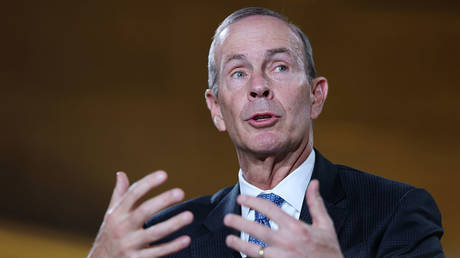
You’ve likely seen the headlines. Chevron’s CEO Mike Wirth didn't mince words at the Milken Institute recently, warning that the world is about to run into a wall of physical oil shortages within weeks. It’s easy to dismiss this as big oil posturing or another cycle of fear-mongering, but the math behind his warning is cold, hard, and honestly, a bit terrifying.
We aren't talking about a theoretical dip in supply or a price hike at the pump that makes you grumble while you tap your credit card. We're talking about dry taps. The closure of the Strait of Hormuz has effectively sliced off 20% of the world’s crude supply. For weeks, the market’s been living on its "savings"—strategic reserves, commercial stocks, and those shadowy fleets that operate off the books. Wirth’s point is simple. The savings account is empty.
The math of an empty pipeline
The energy market is basically a massive plumbing system. When you shut a primary valve like Hormuz, the liquid already in the pipes keeps flowing for a while. You don't feel the pinch on day one. But the transit time for a tanker from the Persian Gulf to Asia is roughly 20 days. To Europe or the US, it's even longer.
We've reached the point where the last tankers to make it out before the closure are finally offloading. Wirth noted that the last scheduled shipment from the Gulf just hit the Port of Long Beach. After that? Nothing.
Asia’s going to feel the heat first. They're the most dependent on Gulf production. When their refineries run dry, the economic contraction won't be a "slowdown"—it'll be a screeching halt. We’re already seeing casualties. Spirit Airlines reportedly went under just days ago as jet fuel costs became impossible to manage. This isn't a drill. It’s a 1970s-style shock, but with a much more fragile global supply chain.
Why the US isn't safe from the fallout
It’s tempting to think we’re insulated here in the States. After all, the US is a net exporter of crude. But oil is a global commodity. If Asia and Europe can’t get their hands on Middle Eastern crude, they’ll start outbidding everyone for American barrels. Prices don't stay local.
Strategic reserves were meant for this, but we’ve spent years tapping into them to keep gas prices palatable for voters. You can’t use the same gallon of oil twice. Wirth’s warning highlights that the buffers are gone. When demand has to "move to meet supply," that’s economist-speak for people losing their jobs because factories can't afford the lights.
Don't buy into the idea that renewables can just flip a switch and fill the gap. That’s a long-term fix for a right-now problem. Our infrastructure, our shipping, and our heavy industry still run on the dense energy only hydrocarbons provide. If that 20% hole in the global bucket isn't plugged, the global economy shrinks. It's that simple.
The shadow fleet and the end of the buffer
For a while, "shadow fleets"—tankers operating outside of standard sanctions and tracking—kept things moving. They’re the black market of the energy world. But even they have limits. You can only hide so much volume. Wirth is telling us that these hidden reserves are officially tapped out.
What's coming next isn't just about expensive gas. It's about the products made from oil. Plastic, fertilizer, medicines. The ripple effect starts at the Strait and ends in your grocery bill. If you think inflation was bad last year, wait until the physical shortages hit the shipping lanes.
Preparing for the squeeze
You don't need to be a prepper to see the writing on the wall. Here’s what's actually useful to do right now.
- Lock in transport costs. If you run a business that relies on shipping or logistics, don't wait for the June price hikes. Settle your contracts now.
- Watch the Asian markets. Watch the manufacturing hubs in South Korea and Japan. When their factory output drops, your supply chain for electronics and parts is about to break.
- Audit your energy dependence. Whether it's your home or your business, look at where you're most vulnerable to a 50% spike in energy costs.
The era of cheap, easy energy flow is on a forced hiatus. Wirth isn't just talking to investors; he's talking to anyone who breathes and buys things. The "weeks" he mentioned are ticking down. It's time to stop treating energy security like a political talking point and start treating it like the survival metric it is.
Chevron CEO warns of global oil shortages
This video provides a direct look at Mike Wirth’s commentary on the tightening supply and the specific risks surrounding the Strait of Hormuz.