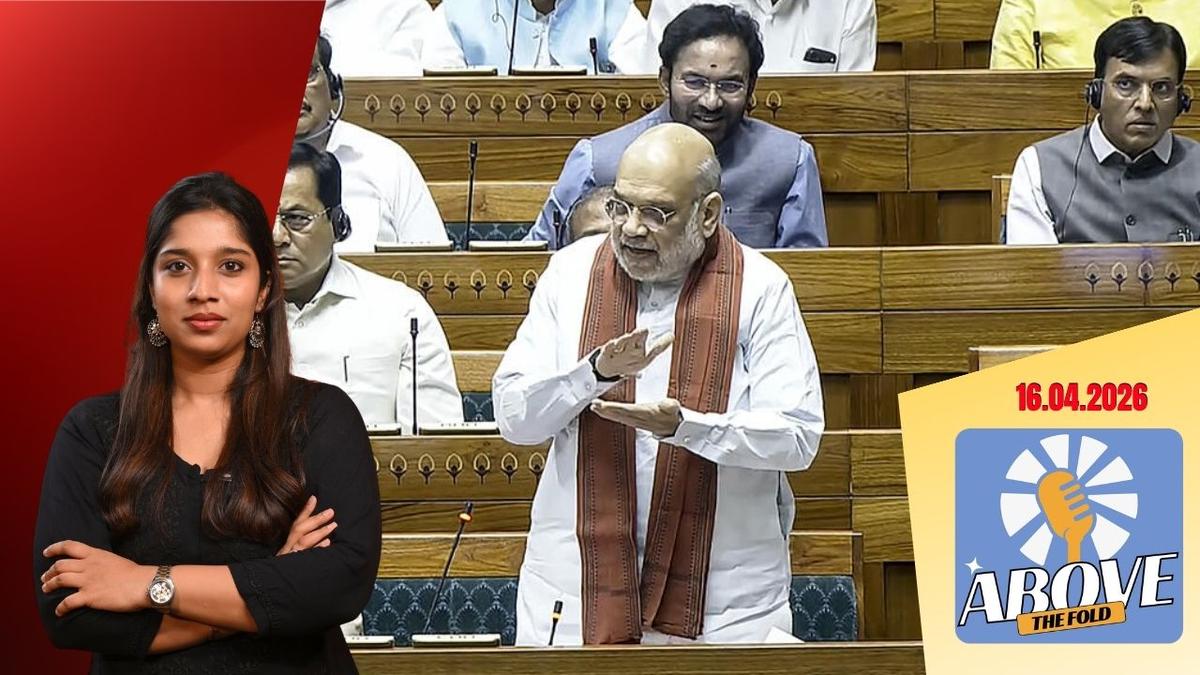
The current parliamentary friction regarding the delimitation of constituencies is not a mere procedural dispute but a fundamental conflict between demographic expansion and federal equilibrium. At its core, the crisis represents a breakdown in the Apportionment Logic used to distribute legislative power. Since 1976, India has effectively decoupled population growth from political representation via the 42nd Amendment, a freeze that was extended to 2026. As this deadline arrives, the nation faces a mathematical inevitability: the transition from a frozen 1971 census baseline to the contemporary 2021/2024 data will trigger a massive northward shift in political gravity.
The Three Pillars of Legislative Malapportionment
The current debate rests on three distinct structural tensions that have been ignored for five decades. Each pillar represents a different failure point in the current governance architecture.
1. The Demographic Penalty
Southern states, specifically Tamil Nadu, Kerala, and Andhra Pradesh, successfully implemented population control measures in accordance with national directives in the late 20th century. By contrast, northern states like Uttar Pradesh and Bihar maintained higher fertility rates. A standard delimitation—adjusting seats to match current population counts—functions as a retroactive penalty for state-level policy success. If the Lok Sabha expands from 543 to the projected 848 seats based on current census estimates, the Northern belt could gain over 30% more representation, while the South’s relative weight in the Union would diminish.
2. The Fiscal-Political Divergence
A widening gap exists between where tax revenue is generated and where political power resides. The southern states contribute a disproportionate share to the national GDP and the divisible tax pool. A delimitation exercise that shifts more seats to the north creates a scenario where the states funding the Union have less say in how those funds are allocated. This is a classic Agency Problem in federalism, where the "principals" (the high-contributing states) lose oversight over the "agents" (the central government, increasingly dominated by populous northern blocs).
3. The Representation Gap
Conversely, ignoring delimitation violates the "One Person, One Vote" principle. Currently, a Member of Parliament (MP) from Rajasthan or Uttar Pradesh may represent nearly 3 million constituents, whereas an MP from Lakshadweep or parts of the Northeast represents a fraction of that number. This creates a Constituency Weight Disparity where the individual vote of a citizen in a high-growth state is mathematically diluted compared to a citizen in a low-growth state.
The Mathematical Model of Seat Reallocation
To understand the scale of the "erupting row" in Parliament, one must quantify the shift. The current seat allocation is based on the 1971 census, when India's population was approximately 548 million. The projected 2026 population figures exceed 1.4 billion.
The Expansion Function
The proposed expansion of the Parliament house (Sengol and the new chamber) provides the physical infrastructure for up to 888 seats in the Lok Sabha. The seat distribution $S_i$ for state $i$ is traditionally calculated as:
$$S_i = \left( \frac{P_i}{\sum P} \right) \times T$$
Where $P_i$ is the state population and $T$ is the total number of seats. If $T$ increases to 848, the northern states move from a combined seat count of approximately 145 to nearly 230. The Southern block, currently at 129, would see a negligible increase in absolute numbers but a drastic fall in Percentage of Total House (PoTH).
Strategic Bottlenecks in the Delimitation Commission
The Delimitation Commission is a quasi-judicial body whose orders cannot be questioned in a court of law. This "Ouster of Jurisdiction" creates a high-stakes environment where the commission's methodology becomes the sole point of failure.
The Problem of the Base Year
The 84th Amendment Act (2001) mandated that while boundaries within states could be redrawn using the 2001 census, the total number of seats per state would remain fixed to the 1971 figures until after the first census following 2026. The delay of the 2021 Census due to the pandemic and subsequent logistical hurdles has introduced a Data Latency Risk. Using 2011 data for a 2026 exercise is statistically unsound; using 2024 projections is legally contentious.
The Electoral Boundary Friction
Redrawing boundaries (delimitation) often leads to "Gerrymandering by Omission," where specific demographic pockets are split to dilute their collective voting power. In the current parliamentary session, the opposition's primary concern is that the delimitation process will be used to systematically disadvantage regional parties whose influence is concentrated in specific geographic or linguistic clusters.
Federalism as a Zero-Sum Game
The primary error in the "Above the Fold" analysis is the treatment of delimitation as a simple administrative update. In a federal structure, power is a zero-sum game. For every seat gained by the Hindi Heartland, the relative bargaining power of the non-Hindi states decreases.
The Rajya Sabha Cushion
Some analysts suggest that the Rajya Sabha (Council of States) could serve as a check. However, because Rajya Sabha seats are also allocated based on state assembly strength—which is itself determined by population-based delimitation—the imbalance propagates through both houses of Parliament. This creates a Systemic Bias Loop.
The Linguistic and Cultural Dimensions
India's federalism is built on the 1956 linguistic reorganization. Delimitation threatens to upset the "Linguistic Compact." If one linguistic group gains a two-thirds majority in Parliament through sheer population volume, they gain the power to amend the Constitution unilaterally, potentially overriding the interests of the linguistic minorities who are economically more productive but demographically stagnant.
Mitigation Frameworks and Alternative Logic
Since the standard population-based model leads to a federal breakdown, three alternative frameworks are currently being debated in high-level policy circles to resolve the deadlock.
1. The Weighted Representation Model
This model introduces a "Success Variable" into the seat allocation formula. Instead of raw population, the formula could weight states based on human development indices (HDI), per-capita GDP contribution, or adherence to the National Family Welfare Program. This would neutralize the demographic penalty but would require a constitutional amendment to redefine the "One Person, One Vote" standard into "One Unit of Contribution, One Vote," which is legally perilous.
2. The US Senate Parallel
A more radical proposal involves fixing the Lok Sabha at its current 1971 ratios while expanding the Rajya Sabha to give every state equal representation, regardless of size, similar to the United States Senate. This would decouple the "People's House" (population-based) from the "States' House" (equality-based). However, under the Indian Constitution, the Rajya Sabha lacks the financial powers (Money Bills) of the Lok Sabha, making this a symbolic rather than a functional fix.
3. The Capped Expansion Strategy
The government may opt to increase the total number of seats so that no state loses an absolute number of seats, while the high-growth states gain enough to satisfy the proportionality requirement. This is the path of least resistance but results in an unwieldy Parliament of nearly 1,000 members, leading to Legislative Inefficiency and the dilution of the individual MP’s ability to participate in debate.
The Operational Reality of the 2026 Deadline
The "eruption" in Parliament is timed with the expiration of the 84th Amendment's moratorium. The government's move to link delimitation with the Women’s Reservation Bill (Nari Shakti Vandan Adhiniyam) was a masterful strategic pivot. By making the implementation of women's quotas contingent on delimitation, the administration has framed opposition to delimitation as opposition to gender parity.
The Sequential Dependency
- The Census: A full house-to-house enumeration must be completed.
- The Publication: Data must be codified and released, including migration patterns.
- The Commission: Appointment of a retired Supreme Court judge to lead the Delimitation Commission.
- The Draft: Publication of draft maps for public feedback.
- The Presidential Order: Finalizing the boundaries.
The "What Happened" in Parliament is the realization that the first step (the Census) is likely to be fast-tracked to meet the 2026 sunset clause. The opposition’s walkouts and protests are a reaction to the lack of a State-Level Guarantee that their political relevance will be preserved.
The Cost Function of Delay
Maintaining the status quo is equally dangerous. As the population grows, the distance between the representative and the represented increases. In 1951, one MP represented about 700,000 people. Today, that number is over 2.5 million. This creates a Representation Deficit that undermines the quality of local grievance redressal and national policy feedback.
The "Above the Fold" narrative fails to mention that the longer the freeze continues, the more violent the eventual correction will be. If the freeze is extended to 2051, the disparity will be so great that the resulting seat shift would likely trigger a constitutional crisis or secessionist rhetoric in states that feel disenfranchised.
The Strategic Playbook for 2026
The resolution will not be found in a simple vote but in a complex Federal Grand Bargain. Any successful delimitation must include:
- A Constitutional Guarantee on Fiscal Autonomy: Ensuring that the Finance Commission's formulas are tweaked to prevent seat-rich states from siphoning off the tax revenue of seat-poor states.
- The Bifurcation of Large States: Breaking down monolithic entities like Uttar Pradesh into smaller administrative units (e.g., Paschim Pradesh, Purvanchal) to prevent any single state from holding a veto over the entire Union.
- An Institutionalized Ceiling: Implementing a cap on the maximum number of seats any single state can hold in the Lok Sabha, regardless of population, to ensure a multi-polar legislative environment.
The current parliamentary row is the opening bell of a decade-long negotiation over the identity of the Indian Republic. It is a transition from a post-colonial centralized state to a modern, demographically diverse federation where the math must finally catch up to the geography.