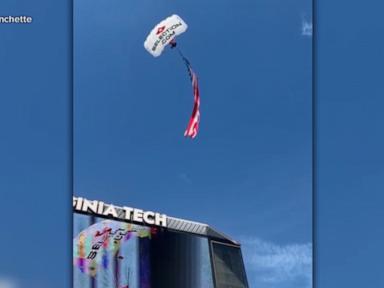
The intersection of high-velocity aerial maneuvers and densely populated stadium environments creates a high-variance risk profile that traditional safety protocols often fail to quantify. When a skydiver strikes a stadium scoreboard during a pre-game demonstration, it is rarely the result of a single mechanical failure; instead, it is the culmination of a "Swiss Cheese" model of failure where atmospheric variables, site-specific turbulence, and human cognitive load align to breach established safety margins. To understand the gravity of these incidents, one must move beyond the emotional narrative of the survivor and dissect the physical and operational constraints that govern precision canopy control.
The Physics of Terminal Precision and Obstacle Conflict
A stadium is not a neutral landing zone. It is a complex aerodynamic "canyon" characterized by unique thermal gradients and wind shear. When a parachute—specifically a high-performance square or elliptical canopy—enters the airspace above a bowl-shaped structure, it encounters the "stadium effect." This involves wind hitting the exterior walls, spilling over the rim, and creating a rotor of turbulent air on the leeward side. Meanwhile, you can read related events here: The Architect of a Fragile Peace.
The mechanics of the collision involve three primary variables:
- The Glide Slope Constraint: Modern demonstration canopies are designed for high lift-to-drag ratios. However, a scoreboard represents a vertical obstacle that disrupts the expected flight path. If a pilot encounters a sudden downdraft (sink) while attempting to clear the stadium rim, the glide slope flattens, placing the vertical obstruction directly in the flight path.
- Kinetic Energy Transfer: Damage is a function of velocity and mass. A skydiver traveling at 20–30 mph relative to the ground carries significant momentum ($E_k = \frac{1}{2}mv^2$). Striking a rigid steel and LED structure results in a near-instantaneous deceleration, where the energy that should have been dissipated through a landing flare is instead absorbed by the jumper’s skeletal structure and the equipment’s suspension lines.
- The Flare Window: To land safely, a pilot must "flare"—toggling the brakes to convert forward speed into lift. A collision with a scoreboard usually occurs mid-flight or during the final turn, effectively "killing" the wing before the flare can be executed, leading to a secondary freefall or a tumble into the stands.
The Cognitive Bottleneck in High-Pressure Environments
The psychological profile of a demonstration jumper is built on a foundation of thousands of repetitions. Yet, the environment of a college football game introduces "novelty stress." The presence of 50,000 to 100,000 spectators, pyrotechnics, and tight broadcast timing windows creates a cognitive load that can lead to "target fixation." To see the bigger picture, we recommend the recent analysis by NBC News.
In aviation psychology, target fixation occurs when a pilot becomes so focused on an obstacle or a specific landing spot that they inadvertently steer toward it or lose situational awareness of their peripheral environment. When the scoreboard becomes a threat, the brain’s instinctual focus on that threat can paradoxicaly inhibit the motor skills required to execute an emergency flat turn or a deep-brake stall to avoid impact.
The decision-making process in the final 200 feet of descent is binary and happens within a 2-to-4-second window. The jumper must choose between:
- The Planned Line: Maintaining the path to the 50-yard line despite deteriorating air quality.
- The Contingency Path: Aborting the target to land in the stands or a "dead zone" of the field, which carries its own risks of spectator injury.
The friction between professional pride (hitting the target for the crowd) and safety-driven abortion of the mission is where most tactical errors originate.
Environmental Variables and The Boundary Layer Problem
Stadiums generate micro-climates. The heat retained by concrete stands and the artificial turf creates localized thermals—rising pockets of warm air. These thermals interact with the ambient wind to create unpredictable "bumps" and "holes."
The Wind Gradient
As a skydiver descends, wind speed typically decreases near the ground due to friction with the Earth's surface. However, in a stadium, the "boundary layer" is chaotic. Airflow is forced through narrow tunnels and over high walls, creating Venturi effects where wind speed can actually increase at specific altitudes above the field. A jumper who calibrated their approach based on the winds at 1,000 feet may find themselves "pushed" or "held" in a manner that makes clearing a 50-foot scoreboard impossible without aggressive, and dangerous, toggle input.
Equipment Limitations
The gear used in these demonstrations is often a compromise. While a large, docile canopy is safer for landing in tight spaces, it is more susceptible to being tossed by turbulence. Conversely, a small, high-performance canopy handles wind better but requires much higher landing speeds and has a much smaller margin for error. If the jumper is using a canopy with a high wing-loading ratio, any correction made to avoid a scoreboard will result in a significant loss of altitude, often more than the jumper has available.
Quantifying the Margin of Error
To evaluate the safety of an aerial demonstration, we must look at the "Safety Buffer Metric." This is the distance between the lowest point of the flight path and the highest obstacle, divided by the variance in wind speed.
- Nominal Buffer: 15–20 meters of clearance.
- Critical Buffer: < 5 meters of clearance.
When the buffer enters the critical zone, the jumper is no longer flying the canopy; they are reacting to the environment. In the incident in question, the intersection of the glide path and the scoreboard height suggests a "Negative Buffer" scenario where environmental sink surpassed the aerodynamic lift available to the wing.
Failure Analysis of the Safety Chain
Every stadium jump requires a Ground Safety Officer (GSO). The role of the GSO is to monitor wind speeds on the field and communicate via radio or signal to the jumpers. The breakdown in these scenarios usually occurs at one of three points:
- Communication Latency: The wind at the top of the scoreboard may be 15 knots while the wind at the field level is 5 knots. If this shear is not communicated in real-time, the jumper enters the stadium with an incorrect mental model of the air.
- Go/No-Go Thresholds: Most demonstration teams have a maximum wind gust limit (often 15–20 mph). However, these limits often fail to account for directionality. A 10 mph wind coming from a "bad" corner of the stadium can be more dangerous than a 20 mph wind coming from a clean, open end.
- The "Show Must Go On" Bias: External pressure from event organizers can subtly influence a team’s risk assessment. The cost of a "no-jump" in terms of reputation and contract fulfillment creates a cognitive bias toward attempting the landing despite marginal conditions.
Strategic Realignment of Aerial Risk Management
The survival of a jumper after hitting a scoreboard is a testament to equipment durability and physical resilience, but it represents a failure of the risk mitigation system. To prevent future kinetic impact events, organizations must shift from a "pilot-centric" model of safety to a "systems-centric" model.
- LiDAR Air Mapping: Deploying portable LiDAR units to map real-time turbulence and wind rotors inside the stadium bowl prior to the jump. This data should be fed to jumpers via heads-up displays or simplified audio cues.
- Mandatory Offset Landing Zones: Redefining "success" as a landing within a broad safe zone rather than a specific logo. If an obstacle like a scoreboard exists on the approach path, the landing target must be shifted a minimum of 40 meters laterally to ensure that a total canopy collapse would still result in a clear fall to the turf.
- The Third-Party Scrutineer: Introducing an independent safety officer who has no affiliation with the jump team or the athletic department, empowered with the sole authority to scrub a jump based on objective atmospheric sensors.
The move toward more aggressive stadium architecture—taller scoreboards, more vertical seating, and partial roofs—means the "stadium effect" will only become more pronounced. Professional teams must treat the stadium air as a hazardous fluid environment rather than an empty void. The focus must shift from the narrative of the "miraculous survival" to the cold reality of the "avoidable impact." Any demonstration where a jumper is forced into the vicinity of a scoreboard indicates a failure in the pre-jump flight plan, and subsequent operations must be suspended until the glide-slope-to-obstacle ratio is recalibrated for the specific architectural footprint of the venue.


:strip_icc()/pic2513216.jpg)