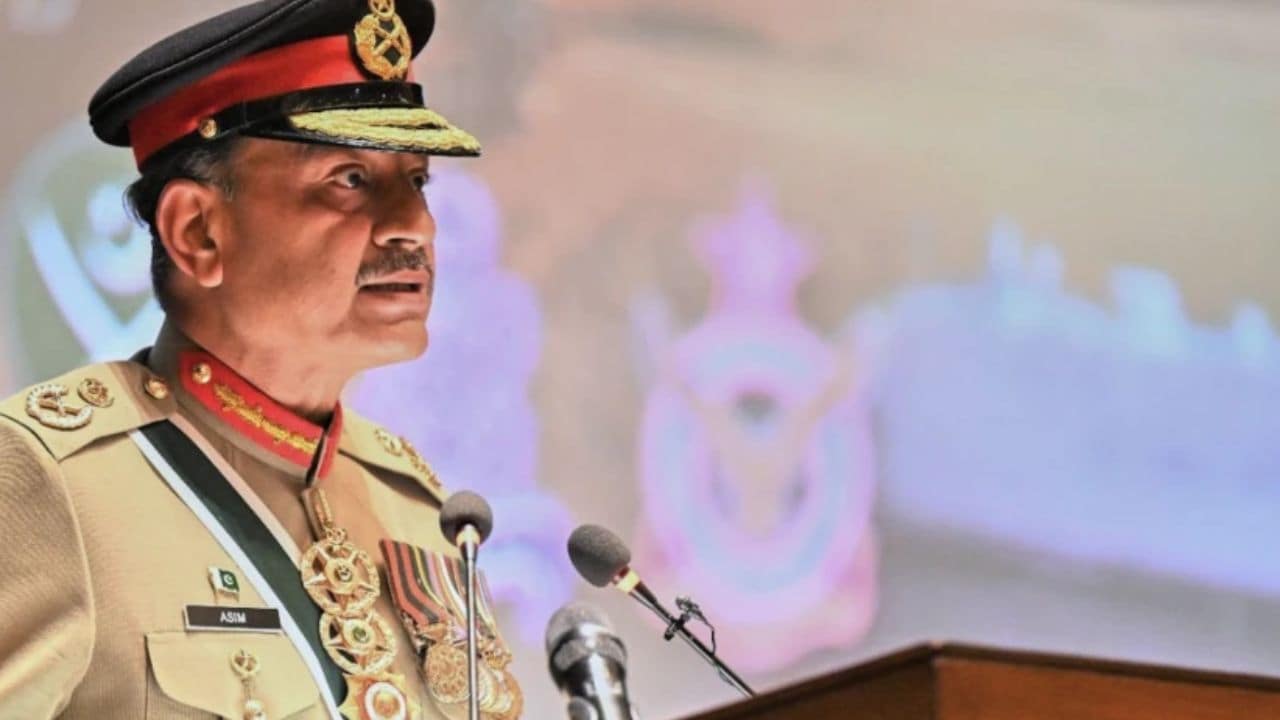
The arrival of Pakistani Army Chief General Asim Munir in Tehran for a second round of high-level security dialogues signifies a shift from reactive border management to a formalized strategic alignment. While traditional diplomacy often relies on symbolic gestures of "brotherhood," the current engagement between Iran and Pakistan is driven by a cold calculation of internal stability requirements and the mitigation of non-state actor volatility. The success of these talks depends on the ability of both nations to synchronize their divergent security architectures while navigating the friction of third-party regional interests.
The Dual-Threat Security Matrix
The primary driver for the Tehran summit is the mutual realization that border porousness has become a critical liability for domestic economic agendas. The security relationship between Iran and Pakistan can be modeled as a Zero-Sum Containment Problem where the failure of one state to secure its periphery imposes direct kinetic costs on the other.
We can categorize the operational friction into three distinct silos:
- Sistan-Baluchestan Kinetic Volatility: This involves the movement of militant groups such as Jaish al-Adl. For Iran, this is a matter of territorial integrity and the prevention of radicalization within its Sunni minority. For Pakistan, it is a complex balancing act of managing insurgent spillover that threatens the security of the China-Pakistan Economic Corridor (CPEC).
- Transborder Smuggling and Informal Markets: The illicit trade of fuel and basic commodities creates a shadow economy that bypasses state taxation and strengthens local power brokers who operate outside the central government's command.
- Third-Party Proxy Friction: The presence of external actors—specifically the intelligence footprints of India, the United States, and Saudi Arabia—introduces variables that neither Tehran nor Islamabad can fully control, but both must account for in their bilateral risk assessments.
The Institutional Dominance of the Military Channel
The presence of General Munir, rather than a purely civilian diplomatic corps, reflects the reality that in both nations, the security apparatus dictates the parameters of foreign policy regarding "hard" borders. This military-to-military (M2M) channel is more efficient than civilian oversight for three reasons:
- Unity of Command: Decisive action on border intelligence sharing requires immediate synchronization between the Iranian Revolutionary Guard Corps (IRGC) Ground Forces and the Pakistan Army’s 12 Corps.
- Tactical Commonality: Both institutions view the Sistan-Balochistan region through the lens of counter-insurgency (COIN) rather than social integration. This shared perspective allows for faster agreement on "hot pursuit" protocols and drone surveillance zones.
- Bypassing Political Volatility: While civilian governments in Islamabad may face pressure from various political factions or international donors, the military establishment provides a consistent, long-term partner for Tehran’s permanent security council.
Economic Integration as a Security Function
The Iranian Foreign Ministry’s emphasis on "peace talks" is a misnomer; these are effectively Market Stabilization Talks. Security is the prerequisite for the proposed expansion of bilateral trade to $5 billion. The bottleneck is not a lack of demand, but the absence of a secure logistics framework.
The Border Markets Mechanism
The establishment of joint border markets serves as a strategic de-escalation tool. By formalizing trade, the states attempt to:
- Convert smugglers into legitimate small-batch traders.
- Establish "Zones of Influence" where local tribes have a financial stake in maintaining peace to ensure the flow of goods.
- Reduce the recruitment pool for militant groups by providing a marginal increase in local economic utility.
The limitation of this strategy lies in the Sanction-Compliance Paradox. Pakistan’s banking sector remains deeply integrated with the global SWIFT system and is sensitive to US Treasury Department sanctions. Iran, conversely, operates almost entirely outside this system. Any significant scaling of trade requires a barter mechanism or a non-dollar clearinghouse, both of which introduce high transaction costs and transparency issues.
The Afghanistan Variable
A hidden layer of the Munir-Tehran dialogue is the deteriorating security environment in Afghanistan under the Taliban. Both Iran and Pakistan are grappling with the unintended consequences of the US withdrawal: an emboldened Tehrik-i-Taliban Pakistan (TTP) and a resurgent IS-K (Islamic State Khorasan).
The strategic mapping of this issue reveals a Contagion Effect. If the Taliban cannot or will not contain IS-K, the resulting vacuum forces Iran and Pakistan into a defensive crouch. The Tehran talks likely focused on a "pincer strategy" to monitor Afghan border crossings, ensuring that the instability within Afghanistan does not metastasize into a broader regional conflict that could draw in more significant military resources.
Intelligence Sharing and Technical Constraints
The transition from "welcoming" a delegation to operationalizing a security pact requires a deep level of technical integration that has historically been missing. For a "second round" of talks to be meaningful, the following technical benchmarks must be met:
- Signal Intelligence (SIGINT) Interoperability: Establishing dedicated communication lines between the regional headquarters in Zahedan (Iran) and Quetta (Pakistan) to reduce the time-lag between incident and response.
- Geospatial Coordination: Alignment on drone flight paths to prevent mid-air collisions or "friendly fire" incidents during surveillance operations along the 900km border.
- Database Synchronization: While unlikely to involve full access, a shared "watchlist" of high-priority targets is necessary to prevent militants from using the border as a "reset" point.
The inherent trust deficit between a major non-NATO ally (Pakistan) and a state under maximum pressure (Iran) acts as a hard ceiling on how much intelligence can actually be shared. Each side will inevitably hold back "high-side" data to protect sources and methods, leading to a fragmented operational picture.
The Geopolitical Chessboard: CPEC and the Port of Chabahar
The long-term success of the Iran-Pakistan alignment is tied to the competition—or potential cooperation—between the ports of Gwadar and Chabahar. Historically viewed as rivals, there is a growing realization that neither port can reach its full potential in a high-threat environment.
- The Gwadar Vulnerability: As the crown jewel of CPEC, Gwadar is a primary target for Baloch separatists. Any security breach here is an embarrassment for the Pakistani state and a deterrent to Chinese investment.
- The Chabahar Opportunity: For Iran, Chabahar is the gateway to India and Central Asia, bypassing the Strait of Hormuz.
If Munir and the Iranian leadership can frame these ports as complementary rather than competitive, they create a Trans-Regional Logistics Bridge. This would involve connecting the rail and road networks of both ports, effectively making the entire Makran coast a unified economic zone. However, this requires a level of diplomatic maneuvering that satisfies both Chinese and Indian interests—a task that remains the most significant hurdle to regional stability.
Strategic Recommendation for Regional Stability
The focus must shift from high-level summits to the institutionalization of the Border Management Committee (BMC). To move beyond the current impasse, the following steps are required:
- Depoliticize the Gas Pipeline: The Iran-Pakistan gas pipeline must be viewed as a security asset. Energy interdependence creates a "Mutual Assured Loss" scenario that incentivizes both states to protect the infrastructure from non-state actors.
- Implement a Joint Border Patrol Force: Moving from "coordinated" patrols to a "joint" task force would signal a definitive end to the era of finger-pointing regarding cross-border incursions.
- Formalize the Barter Trade Agreement: To circumvent sanctions, a formalized commodities-for-energy exchange must be established at the state level to provide the necessary liquidity for the $5 billion trade target.
The current engagement is not a sign of an emerging ideological alliance, but a pragmatic response to a deteriorating regional security landscape. The true test of the Munir-Tehran talks will not be found in the joint communiqués, but in the kinetic activity—or lack thereof—along the border over the next fiscal quarter. If the frequency of IED attacks and cross-border skirmishes decreases by a measurable margin, the "second round" can be deemed a tactical success. Failure to reach this threshold will relegate these talks to the long history of unproductive regional posturing.