The Fetish for Roman Concrete
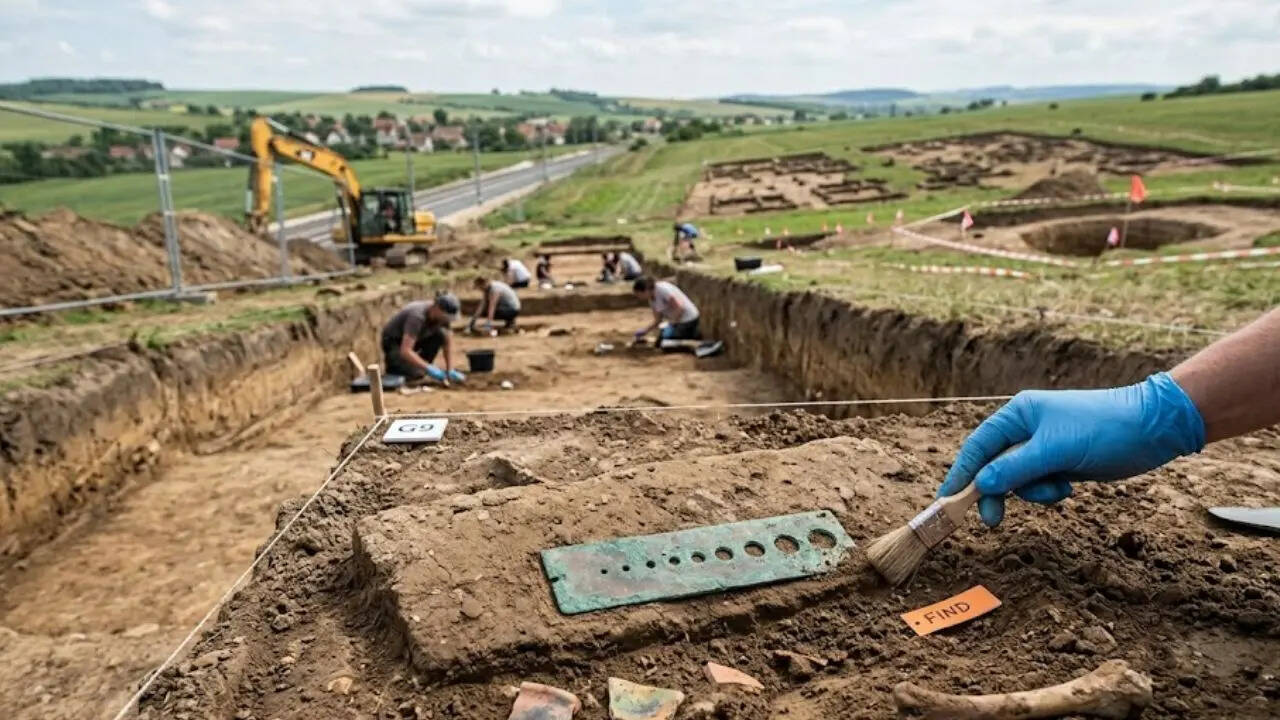
Every time a spade hits dirt in Central Europe and unearths a rusty piece of iron or a fragment of calcified mortar, the archeology world catches a collective case of the vapors. The recent discovery of a 2,000-year-old Roman tool in the Czech Republic is being hailed as a "history-rewriting" moment for ancient engineering.
It isn't.
It is a piece of debris. To claim that a single artifact found on the periphery of the Empire suddenly "proves" a sophisticated Roman industrial presence in the region is a reach so desperate it ignores the laws of logistics and the reality of ancient supply chains. We have fallen into a trap of Roman Exceptionalism, where we assume every advancement in history was a gift from a Mediterranean superpower, ignoring the far more gritty and impressive reality of local adaptation and the limits of imperial reach.
The Myth of the Imperial Handout
The mainstream narrative suggests that when the Romans marched, they brought a "civilizing" kit of high-tech tools that transformed "barbarian" landscapes. This is a fairy tale. In reality, the frontiers were messy, underfunded, and reliant on local knowledge that often surpassed the rigid standards of the capital.
When you find a "Roman" tool in the Czech Republic, you aren't looking at a sign of superior engineering spreading like a software update. You are likely looking at one of three things:
- Loot: A local chieftain stole it and didn't know how to maintain it.
- Trade Waste: A merchant sold a defective implement to a remote outpost.
- Local Imitation: A Germanic smith saw a Roman design and built a version that actually worked for the local soil conditions.
Archeologists love the "Roman" label because it gets grants. It sounds prestigious. But calling this tool a "game-changer" for engineering history is like finding a discarded iPhone in a remote village today and claiming the villagers have mastered semiconductor fabrication.
Why Ancient Supply Chains Actually Sucked
The biggest misconception in popular history is the idea of "Roman efficiency." Rome was a bureaucracy of bloat. Shipping heavy iron tools from the heart of the Empire to the northern frontiers was a logistical nightmare that made zero economic sense.
Consider the energy expenditure. To transport a single heavy-duty construction tool across the Alps, you needed a massive caloric input from draft animals and labor. By the time that tool reached the Czech border, its "cost" in resources often exceeded its utility.
Local smiths in the region were already working with bog iron. They had their own tempering techniques. They understood the thermal expansion of the specific metals available to them. To suggest that a Roman tool "rewrites" their history is an insult to the people who were actually living and building there. The true engineering marvel wasn't the tool itself—it was the local ability to ignore Roman "best practices" and build structures that didn't require an imperial supply line to maintain.
The Survivor Bias of Stone
We think the Romans were the only ones who knew how to build because they built with stone and concrete. This is the ultimate survivor bias.
Because stone lasts 2,000 years and wood rots in 50, we assume the people outside the Empire were living in mud huts while the Romans lived in the future. If we look at the mechanical complexity required to manage a Germanic timber fortification or a Celtic iron-smelting operation, the "gap" in engineering narrows to almost nothing.
The tool found in the Czech Republic is likely an outlier—a curiosity. It didn't "modernize" the region. In fact, if you look at the metallurgical analysis of many frontier tools, they are often of lower quality than the locally forged items because they were mass-produced by slave labor in imperial factories rather than being hand-honed by a master smith who knew his life depended on the blade's edge.
The Problem with "Rewriting History"
Whenever an article claims something will "rewrite history," it usually means it adds a tiny footnote that 99% of people will never read. This specific discovery doesn't change the fact that the Romans never permanently settled the Czech Republic. It doesn't change their failure to expand past the Elbe.
What it should do is force us to ask why we are so obsessed with the Roman brand name. Why do we need a Mediterranean stamp of approval to find a region's history interesting?
The real engineering story in the Czech Republic 2,000 years ago wasn't about a Roman trowel or a legionary's pickaxe. It was about how the locals resisted the most powerful military machine on earth using asymmetrical warfare and localized technology. That is the history worth studying.
The Cost of Standardization
In my years analyzing industrial systems, I’ve seen companies destroy their own innovation by forcing a "centralized" toolset on their remote branches. Rome did the same thing. They tried to standardize engineering across vastly different climates and topographies.
The tool found in this excavation is a relic of that failed standardization. It represents the hubris of an empire trying to force its "cutting-edge" (for the time) tech into a landscape it didn't understand.
Stop Looking for "Firsts"
The obsession with being the "first" to discover a Roman influence in a new region is a distraction. It's a marketing tactic for museums.
If we want to actually understand ancient engineering, we need to stop looking at the tools and start looking at the failures. Where did the Roman tools break? Why were they discarded? Usually, it's because they weren't suited for the task at hand. The "superior" Roman engineering often failed in the damp, freezing forests of the north.
The locals didn't need Roman engineering. They were already practicing a form of lean manufacturing and localized resource management that would take the rest of Europe a thousand years to replicate after the Empire collapsed under its own weight.
The Real Engineering Secret
If you want to find the true revolution in ancient history, look at the transition from bronze to iron in the hands of the "barbarian" tribes. They decentralized the heat. They moved the "factories" to the forests. They removed the need for the long-distance tin trade that the Mediterranean powers relied on.
That is the disruption. Not a single iron tool found in a ditch near Prague.
The next time you see a headline about a Roman artifact "changing everything," remember that history is written by the people who kept the records, but it was built by the people who didn't need a permit from a Caesar to innovate.
Ditch the Roman obsession. Look at the mud. Look at the local smiths. That’s where the real engineering lived.