Li Wei wiped the sweat from his eyes, his lungs burning with the familiar, acidic bite of the seventeenth kilometer. Around him, the Beijing half-marathon was a sea of rhythmic breathing and the slapping of rubber against the road. Then he heard it. It wasn't the soft thud of a carbon-plated running shoe. It was a rhythmic, metallic clicking. Precise. Unyielding.
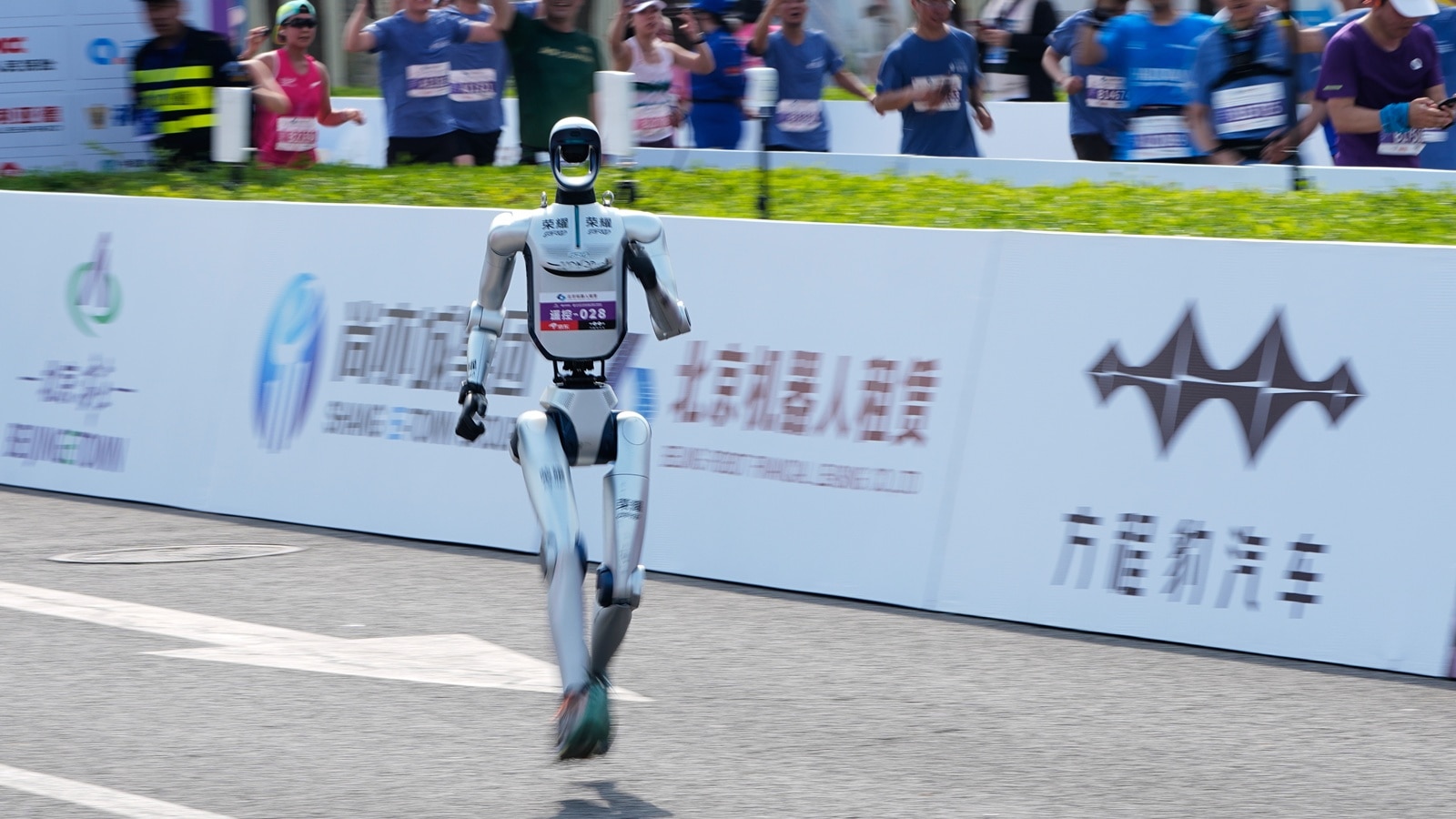
A figure moved past him. It didn't weave through the crowd with the fluid, lateral shifts of a human athlete. It maintained a line so straight it felt like a mathematical insult to the exhaustion of the people surrounding it. The machine—a bipedal humanoid—moved with a gait that looked almost mocking in its efficiency. While Li’s heart rate pushed 170 beats per minute, the robot simply processed data.
This wasn't a science fiction set. This was the April 2026 Beijing Half-Marathon, and the gap between biological evolution and mechanical engineering just evaporated in real-time.
The Ghost in the Race
For decades, the "uncanny valley" was a barrier that kept robots relegated to factory floors or stiff, jerky demonstrations in laboratory hallways. We told ourselves that the complexity of human locomotion—the way our ankles stabilize on uneven cracks, the way our hips rotate to absorb shock—was too nuanced to replicate. We were wrong.
The robots participating in Beijing didn't just finish the race. They dominated the middle-distance metrics. Engineers from firms like Unitree and Xiaomi have moved past the era of clunky hydraulic pistons. They are now using high-torque density motors and reinforcement learning algorithms that allow these machines to "learn" how to run in simulated environments for thousands of virtual years before their feet ever touch actual pavement.
Consider the physics of the stride. A human runner loses energy every time their foot hits the ground; we are essentially a series of controlled falls. These humanoid models, however, are designed with regenerative braking systems in their joints. They recover energy from the impact. While a human marathoner hits "the wall" when their glycogen stores deplete, the robot’s only limit is the energy density of its solid-state battery.
The Invisible Stakes of a Sunday Morning
It is easy to dismiss this as a publicity stunt. Skeptics point out that a robot doesn't feel the "runner’s high" and therefore the achievement is hollow. But that misses the point of why they were on the course.
The half-marathon is the ultimate testing ground for reliability. If a robot can navigate 21 kilometers of unpredictable urban terrain, avoid thousands of moving obstacles (runners), and maintain a pace of four minutes per kilometer without a mechanical failure, it has proven it can survive the human world. This isn't about medals. This is about the commercialization of a workforce that never tires.
In 2025, the global humanoid robot market was valued at roughly $3.9 billion. By 2030, analysts project that number to skyrocket to over $38 billion. Beijing is positioning itself as the epicenter of this surge. The city has established dedicated robotics hubs, providing massive subsidies to companies that can shrink the hardware. They aren't just building toys. They are building the next generation of logistics handlers, emergency responders, and, eventually, home assistants.
A Hypothetical Tuesday in 2028
To understand the weight of that metallic clicking on the pavement, we have to look past the finish line. Let’s imagine a person named Sarah.
Sarah works in a high-volume fulfillment center. For eight hours a day, she walks nearly fifteen miles, lifting boxes and sorting parcels. Her knees ache by noon. She has a high error rate in the final hour of her shift because human brains are wired to drift when bored or tired.
Now, look at the robot from the Beijing race. Strip off the aerodynamic casing and give it two grippers. That machine doesn't have a circadian rhythm. It doesn't need a lunch break. It doesn't file for worker's compensation when its lower back gives out, because it doesn't have a lower back—it has a reinforced steel chassis with a mean time between failures of 20,000 hours.
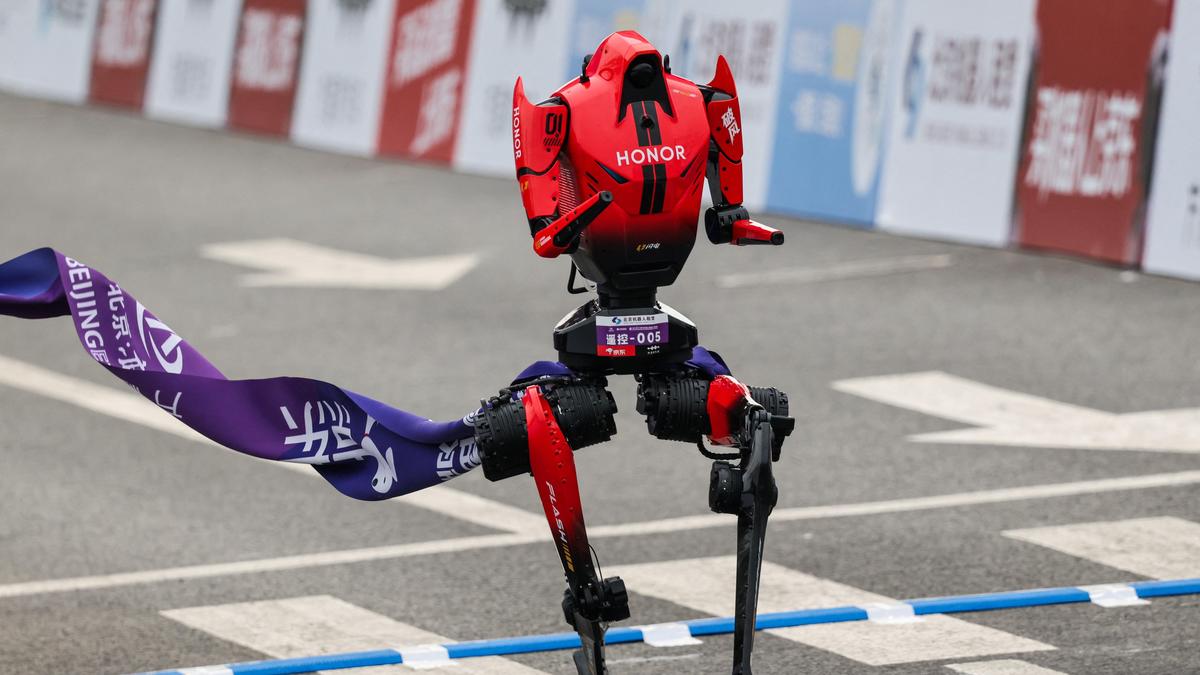
The race in Beijing was a quiet funeral for the idea that "physical labor" is a uniquely human sanctuary. When the lead robot crossed the line, clocking a time that would put it in the top tier of amateur human athletes, it wasn't just breaking a tape. It was breaking the value of the human calorie.
The Geometry of the Stride
Why has this happened so fast? The answer lies in the marriage of Large Language Models (LLMs) and physical actuators.
In the past, you had to hard-code every movement. If the robot hit a pebble, it fell over because it didn't have a "pebble" instruction. Today, these robots use "Vision-Language-Action" models. They see the world through LiDAR and depth cameras, interpret the terrain using neural networks, and adjust their torque output in milliseconds.
- Latency: The human nervous system has a reaction time of about 200 milliseconds.
- Precision: Modern robotic sensors can detect a tilt of 0.01 degrees and compensate before the fall even begins.
- Consistency: A robot does not have "off days." It does not deal with a breakup, a poor night's sleep, or a lack of motivation.
The machines in the Beijing race maintained a heart-rate equivalent of zero. Their "perspiration" was merely the hum of cooling fans pushing air over their processors.
The Quiet Displacement
There is a tension in the air when you watch a machine outperform a human in a feat of endurance. It feels like a betrayal of our biology. We evolved for millions of years to be the ultimate persistence hunters. Our ability to shed heat through sweat and run for hours is what allowed us to outlast prey on the savannah.
Now, we are being outlasted by silicon and aluminum.
The economic implications are staggering. We are moving toward a "Post-Kinetic" economy where the cost of physical tasks will trend toward the price of electricity. If a humanoid robot can be manufactured for $30,000—the price of a mid-range sedan—and operate for five years, the hourly cost of labor drops to less than $3.00. No human can compete with those economics. Not in Beijing, not in Berlin, and not in Boston.
We often talk about AI taking "white-collar" jobs—writing code, generating images, or analyzing spreadsheets. But the Beijing marathon shows that the "blue-collar" moat is drying up just as fast. The robots are literally running toward the jobs that require legs, arms, and a sense of balance.
The Finish Line Without a Pulse
As the sun began to set over the Olympic Forest Park, the human runners filtered through the recovery zones, wrapped in foil blankets, clutching bananas and water bottles. They leaned on each other, sharing stories of the "wall" they hit at mile ten.
In a cordoned-off area near the media tents, the robots stood perfectly still.
They didn't need water. They didn't need praise. A technician plugged a diagnostic cable into a port behind one of the robot's necks, and the data from 21.09 kilometers was uploaded to a cloud server in seconds. Every stumble, every micro-adjustment, and every successful stride was now part of a collective intelligence.
Next year, the machines will be lighter. Their batteries will last longer. Their algorithms will be more refined. They will not remember the cheering crowds or the smell of the spring air in Beijing, but they will remember the exact friction coefficient of the asphalt under the third bridge.
Li Wei sat on the curb, massaging a cramp in his calf, watching the technicians load the machines into a plain white van. He had run his personal best, but for the first time in his life, he felt slow. He looked at his hands—shaking slightly from the effort—and then at the smooth, vibration-free chassis of the machine being lifted into the truck.
The race was over. But the realization was just beginning to sink in for the thousands of people watching. We aren't racing against each other anymore. We are racing against a version of ourselves that never gets tired, never feels pain, and never looks back to see if we are keeping up.
The only sound left in the park was the faint, rhythmic clicking of a late finisher’s shoes, a sound that suddenly felt very, very old.