The air inside the Berlin gallery is sterile, filtered, and heavy with the smell of floor wax and ambition. You walk in expecting art. You leave wondering who actually owns your reflection.
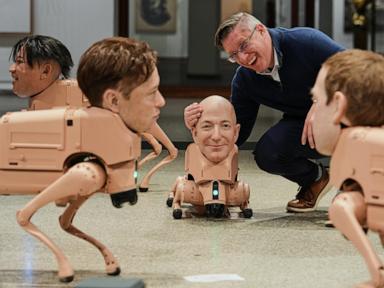
Before you stands a pack of four-legged machines, their metal joints clicking with the rhythmic, predatory grace of real hounds. But these aren't guard dogs. They are avatars. Attached to their mechanical necks, replacing the familiar snout and ears, are hyper-realistic sculptures of Elon Musk and Mark Zuckerberg. They trot in place. They tilt their heads with uncanny, calculated curiosity. They look at you, and for a split second, you feel the urge to pet them. Then, the feeling curdles into something colder.
This is the work of Beeple, the digital provocateur who turned the art market upside down with his high-concept NFTs. Now, he has stepped out of the screen and into the physical room. He isn't just showing us robots. He is holding a mirror to the way we have surrendered our agency to the titans of our digital age.
Think of an office worker, let’s call her Sarah. She spends ten hours a day feeding data into algorithms owned by these very men. She optimizes, she clicks, she tracks. She is, for all intents and purposes, a leash-holder for a machine she doesn't fully understand. When Sarah watches these robots pace across the white gallery floor, she isn't seeing sculpture. She is seeing the physical manifestation of her own labor, dressed up in the faces of the people who command the digital infrastructure of her life.
It is a masterful, if terrifying, bit of theater.
The technology behind these machines—the articulated chassis, the autonomous navigation—is borrowed from the real world of industrial robotics. Companies have been developing these platforms for years, promising to navigate disaster zones or inspect hazardous pipelines. They are feats of engineering, cold and utilitarian. But Beeple has stripped away the utility and replaced it with a social commentary that feels like a slap in the face. By pinning the heads of the world’s most powerful tech architects onto the bodies of autonomous drones, he forces a confrontation between the builder and the tool.
We are used to these men appearing on our screens. They are gods of the interface, architects of the "community guidelines" and the "user experiences" that dictate how we love, fight, and trade. We see them in interviews, dressed in comfortable athleisure, projecting the ease of people who have already won. But seeing them as beasts of burden—or perhaps, as beasts of dominance—changes the frequency.
One of the robots pivots. Its head follows the motion of a gallery visitor, tracking her eyes with a smooth, unsettling precision. The visitor laughs, a nervous, jagged sound. She pulls out her phone to record it. The irony is thick enough to choke on. She is using a device running software built by the very men represented by the dog, to document the dog mocking the men. We are caught in a closed loop of our own making.
The stakes here are not about robots. They never are. The stakes are about the creeping normalization of surveillance and the way we have allowed the boundaries of our private selves to be eroded by companies that view us as nothing more than patterns to be predicted. When we look at these robotic proxies, we aren't just looking at Musk or Zuckerberg. We are looking at the infrastructure of the attention economy. We are looking at the digital leashes we willingly hold, believing they keep us safe, only to realize we are the ones being walked.
I recall a conversation I had with an engineer working in robotics years ago. He told me that the hardest part of building autonomous systems wasn't the movement; it was the trust. How do you make a human trust a machine? You give it a face. You give it eyes that blink. You give it a gait that mimics life. By doing so, you bypass the critical thinking centers of the brain and trigger an emotional response. We are hardwired to bond with creatures that move and look back at us.
Beeple knows this. By putting these specific faces on these specific machines, he is hacking our empathy. He is weaponizing the very design principles used by the companies these men lead to keep us scrolling. He is using their own playbook against them, turning their calculated humanity into a satire of our own domestication.
The room is silent, save for the hum of the servos and the soft thud of metal feet on concrete. There is no music. No didactic plaques explaining the genius of the installation. There is only the movement. The pack turns together. They are synchronized, a collective consciousness of silicon and motor oil.
Does this represent the future? If it does, it is a future where the distinction between the master and the machine has dissolved entirely. We are witnessing the birth of a new kind of mythology. In the old myths, humans were pawns of the gods. In the new myth, the gods are becoming the machines they built, and we are the ones left to marvel at the spectacle while our personal data is harvested in the background.
There is a profound loneliness in the gallery. Not because the art is sad, but because the truth of it is so undeniably mundane. We know the power these men wield. We know the reach of their networks. Yet, seeing it miniaturized and trapped in a cage of artifice feels like an indictment. We are not just subjects in their empire; we are the fuel.
The robots continue their loop. They do not tire. They do not get hungry. They simply process the space, map the corners, and watch the humans watching them. It is a perfect, terrifying efficiency.
As you head toward the exit, you catch your own reflection in a glass partition. You look at your phone, still gripped tightly in your hand. You realize that you’ve been standing there for twenty minutes, and not once have you checked your notifications. For a brief window, you were fully present, observing the capture.
But the door opens. The street noise of Berlin rushes in—the honking cars, the chatter of commuters, the digital pulse of a city that never stops consuming. You step out, and the leash tightens. You check your phone. A notification lights up the screen, a tiny, glowing command from the very machine-world you just walked away from.
The robots are still in there, walking their endless, silent circle. But out here, the cycle has already begun again.