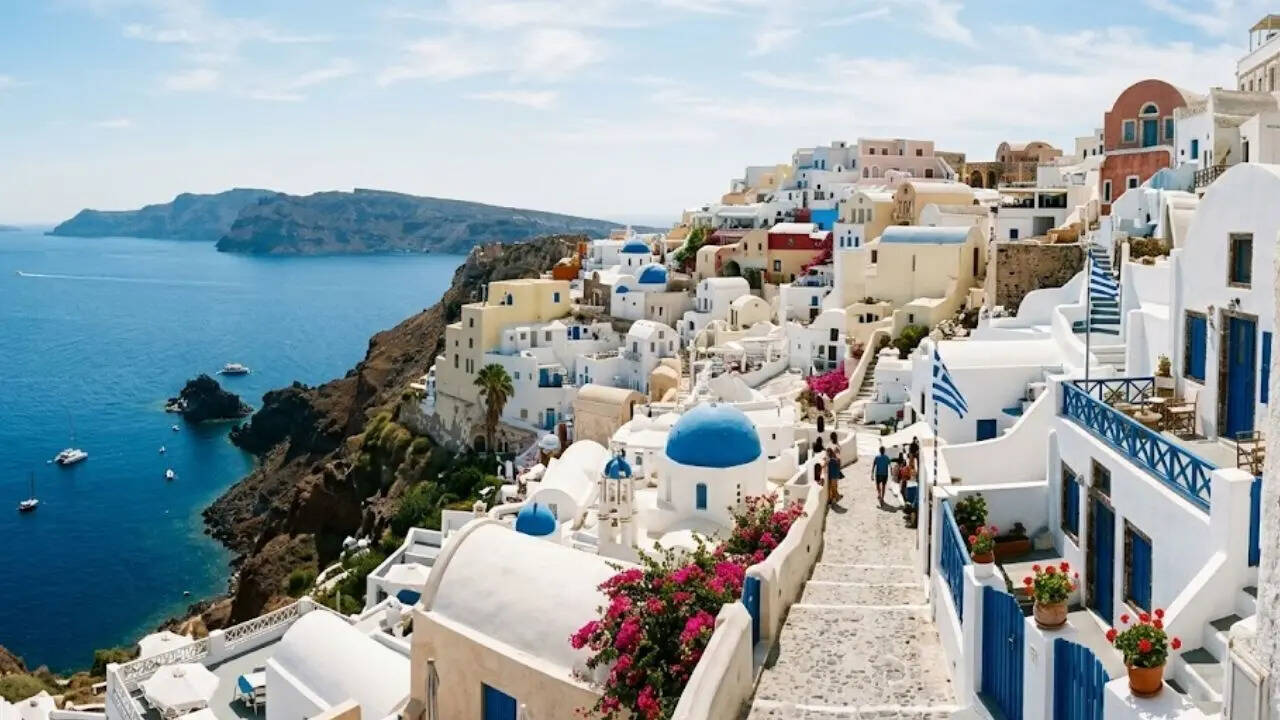
The sun over the Cyclades does not merely shine. It hunts. By midday in July, the light bouncing off the Aegean Sea becomes a physical weight, a white-hot pressure that searches for any dark surface to settle upon. If you stood on the cliffs of Santorini or Mykonos a century ago, looking at a home built of dark, volcanic stone, you would not see a postcard. You would see a furnace.
We have been conditioned to view the blue and white palette of the Greek islands as an aesthetic choice, a deliberate branding of paradise designed to mimic the national flag. We see it on Instagram and think of serenity. We think of art. But the truth of the Aegean is written in sweat, sickness, and survival. Those gleaming white walls were never about beauty. They were a desperate technology of the poor.
The Cooling Breath of Lime
To understand the white, you have to understand the heat. Imagine a fisherman named Nikos in 1920. He lives in a house carved into the caldera, built from the very earth he walks upon: dark, porous lava and sun-baked brick. These materials are sponges for thermal energy. Without the white coating, the interior of a stone house acts like a slow-cooker, absorbing the brutal Mediterranean sun all day and radiating it back into the small, cramped living quarters all night. Sleep is impossible. The air is thick enough to chew.
Nikos does not have air conditioning. He does not even have electricity. What he has is limestone.
In its raw form, calcium oxide—quicklime—was the cheapest material available. When mixed with water to create a wash, it became a transformative tool. Painting a house white was an act of thermal warfare. A white surface reflects the vast majority of solar radiation, preventing the stone beneath from drinking in the heat. It was a primitive, brilliant form of climate control. A whitewashed house could stay ten degrees cooler than its raw stone neighbor.
This wasn't a choice made for the neighbors to admire. It was the only way to ensure that, after a day of hauling nets under a ruthless sun, a man could step into his home and find a moment of mercy.
The Ghost of 1938
But heat was not the only enemy. If the white was for comfort, the blue was for something far more sinister.
In the late 1930s, Greece faced a terrifying specter: cholera. The islands, with their tight alleys and shared water sources, were tinderboxes for disease. Hygiene was a luxury the rural poor could rarely afford. Then came the mandate of 1938.
The Greek dictator Ioannis Metaxas issued an order that every house in the islands must be whitewashed. This wasn't a beautification project. It was a public health intervention.
Limestone is a natural disinfectant. It is alkaline. It is antimicrobial. By coating the porous stone of every dwelling in lime, the government was essentially "bleaching" the islands. The white wash sealed the cracks where bacteria lived and provided a sterile layer over the rough-hewn lives of the villagers. When you see those blindingly bright walls today, you are looking at the remnants of a massive, nationwide quarantine effort. The islands became white because they had to be clean, or they would die.
The Color of the Deep
Then there is the blue. That specific, piercing shade of "Loulaki" blue that defines every dome and window frame from Oia to Paros.
The story we tell ourselves is that the blue represents the sea and the sky. It’s a poetic thought, but poetry is expensive, and the islanders were not. The blue didn't come from a painter's palette; it came from the laundry room.
Loulaki was a blue cleaning powder—a bluing agent—used by every housewife to keep clothes from yellowing. It was cheap. It was in every cupboard. When the villagers looked at their freshly whitewashed homes, they saw a blank canvas that needed a bit of trim. They didn't go to a hardware store to buy expensive pigments. They took a bit of their laundry powder, mixed it into the leftover lime wash, and painted the doors and windows.
It was a marriage of convenience and poverty. The blue was simply what was left over after the chores were done.
Consider the irony: a global symbol of luxury and high-end travel was born from the dregs of a cleaning bucket. We pay thousands of dollars to sit in the shadow of a color that was chosen because it cost nothing.
The Flag in the Stone
History, however, has a way of layering meaning over necessity. While the white was for the heat and the blue was for the budget, there was a period where these colors became an act of silent rebellion.
During the Axis occupation of Greece in World War II, flying the Greek flag was a crime punishable by death. In the islands, the resistance didn't always carry rifles. Sometimes, they carried brushes.
Under the noses of occupying forces, islanders began to paint their homes in the strict patterns of blue and white. They transformed their entire villages into a sprawling, immovable flag. The soldiers walked through streets that screamed Greek identity, but they couldn't arrest a man for painting his own door. The architecture became the anthem. It was a visual defiance that no decree could scrub away.
The Law of the Image
By 1967, the aesthetic had become so powerful that the military junta then in power turned the tradition into a law. They saw the tourism potential of this uniform look. They mandated the colors, stripping away the organic evolution of the islands and replacing it with a rigid, enforced brand.
Today, that law remains in various forms across different municipalities. You cannot simply decide to paint your house ochre or terracotta in the heart of a traditional Cycladic village. The "look" is now a protected asset.
We have moved from survival to sanitation, from rebellion to regulation.
The Weight of the Brush
The next time you walk those cobblestone paths, look closer at the walls. You will see that the white is not a flat, industrial coat. It is thick. It is rounded at the corners. It feels organic, almost like skin.
This is because the whitewash is applied year after year, layer upon layer. Every spring, usually before Easter, the families emerge with their buckets. They fill the cracks. They smooth over the scars the winter salt-spray left behind.
There is a tactile history in those layers. Beneath the top coat lies the blue of a laundry powder from the sixties. Beneath that, the lime that held back the cholera in the thirties. Deep in the grain of the stone, there is the original dark volcanic rock that once made the house a furnace.
We often think of architecture as a finished product, something designed by an architect and executed by a builder. But the Greek islands were not designed. They were grown. They were a collective response to a harsh environment, a way for a people with very little to reclaim their lives from the heat and the plague.
The beauty was an accident. The survival was the point.
The light still hunts. The sea still sprays its salt. And the people still paint. Not because they want to be on a postcard, but because the white stone is the only thing that keeps the Aegean sun at bay, and the blue is the only color that knows the way home.