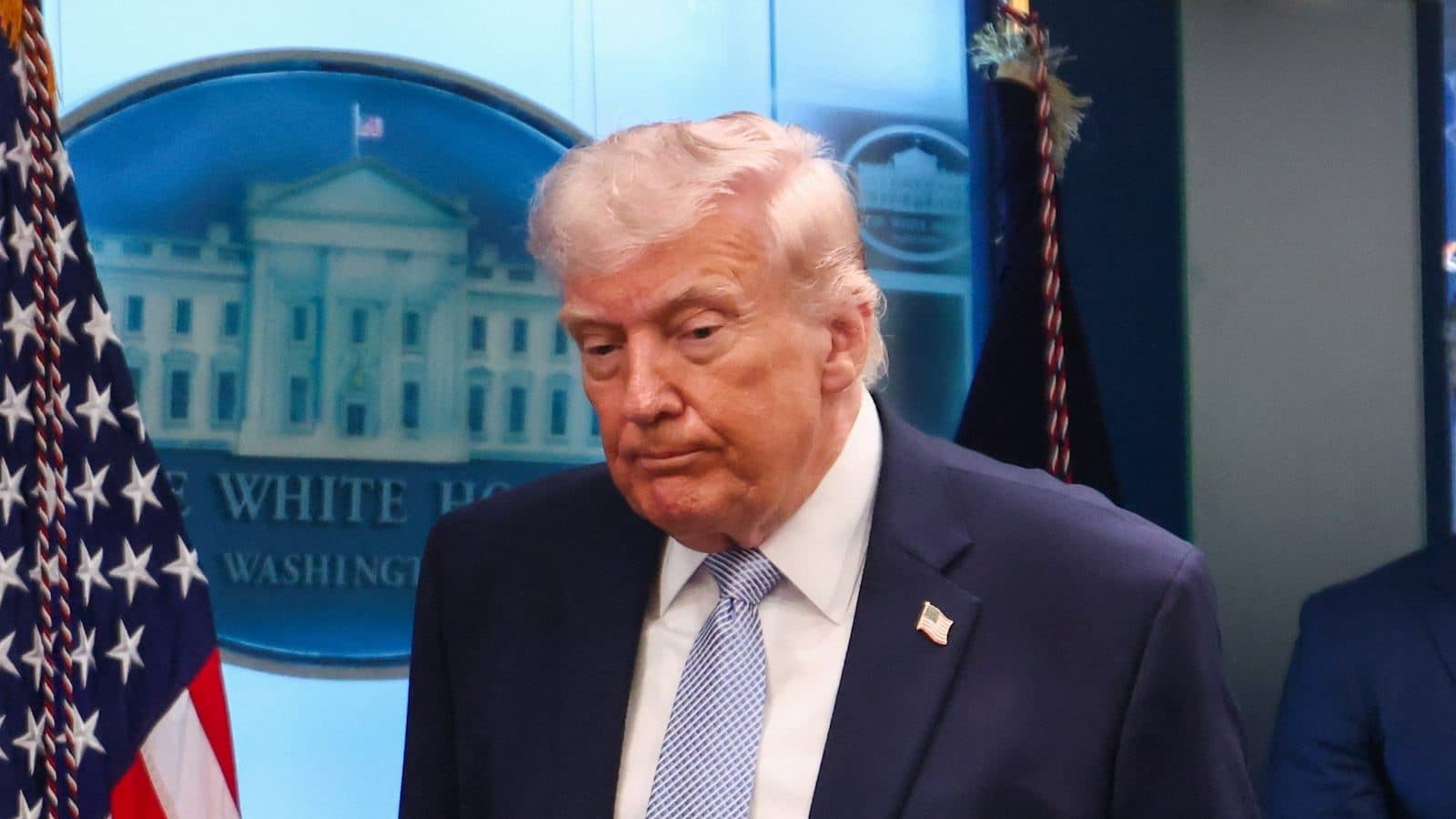
The world’s most critical maritime artery is currently a dead zone, and the person holding the scalpel claims the patient is begging for surgery. On Tuesday, President Trump declared that Iran is in a "state of collapse" and has signaled a desperate urge to reopen the Strait of Hormuz as soon as possible. But the reality on the water—and in the high-stakes shadow talks in Islamabad—suggests this isn't a simple case of a defeated adversary surrendering. It is a calculated, high-leverage standoff where both sides are currently strangling the global economy to see who gasps first.
The Strait of Hormuz, through which 20% of the world’s petroleum and liquefied natural gas usually flows, has been effectively severed since late February. Following the U.S.-Israeli strikes that killed Supreme Leader Ali Khamenei, Tehran pivoted to the only survival mechanism it has left: maritime extortion. By mine-laying, satellite spoofing, and drone strikes, Iran didn't just close a waterway; they erected a digital and physical toll booth that has pushed global oil prices to $108 a barrel and sent domestic gas averages to $4.11 a gallon.
The Architecture of a Dual Blockade
What the public sees as a "closure" is actually a sophisticated, two-tiered strangulation. On one side, Iran’s Revolutionary Guard (IRGC) has been operating a selective access regime. They aren't just blocking ships; they are charging "tolls" exceeding $1 million per vessel for safe passage, favoring "non-hostile" states like China and Pakistan while targeting anyone else.
On the other side, the U.S. launched a counter-blockade on April 13. President Trump’s strategy is no longer about just protecting tankers; it is about starving the Iranian port of Bandar-e Emam Khomeini of the grain and spare parts it needs to function. This "dual blockade" has created a nautical no-man's land where hundreds of ships are currently anchored in holding patterns, waiting for a signal that may never come.
The Economic Decay of Tehran
The "state of collapse" Trump references isn't just hyperbole. The numbers coming out of Iran describe a nation on the brink of structural failure.
- Currency Vaporization: The Iranian rial has plummeted to over 1.1 million per U.S. dollar.
- Infrastructure Paralysis: Rolling blackouts last three to four hours daily because the energy sector cannot maintain its aging equipment under the weight of the latest sanctions.
- The Hunger Factor: Meat has become a luxury. Official data indicates food inflation has exceeded 112%, with cooking oil prices rising by more than 200%.
Iran is currently a hollowed-out shell, but a cornered animal is often the most dangerous. The IRGC still controls the "list"—the specific sequence of ships allowed through the Strait—and they have shown they are willing to fire on tankers, like the Front Gander, even after promising "clearance." This suggests a fracture in Iranian leadership: the diplomats are offering to open the gates to stop the economic bleeding, while the hardline military remnants are doubling down on chaos to maintain their only remaining leverage.
The Technological Siege
This isn't your grandfather’s naval blockade. The reason insurance companies won't touch vessels in the Gulf isn't just because of the risk of a missile. It is the invisible warfare. Iran is utilizing high-intensity GNSS jamming and satellite spoofing to make traditional navigation impossible. A captain looking at his bridge displays might see his ship located ten miles away from its actual position, potentially steering him directly into a minefield or Iranian territorial waters.
The U.S. response has been equally high-tech, using autonomous underwater vehicles to sweep for mines, but the "asymmetric" nature of the conflict favors the disrupter. It costs Iran a few thousand dollars to launch a drone or drop a "dumb" mine; it costs the global economy billions in delayed shipments and spiked insurance premiums.
Why a Ceasefire is Stalling
The primary friction point in the Islamabad talks is the sequence of the "opening." Iran wants the U.S. naval blockade lifted and a total withdrawal of the "counter-blockade" before they clear the mines and stop the spoofing. The Trump administration, bolstered by Secretary of State Marco Rubio, has labeled this unacceptable. They argue that normalizing Iranian control of the Strait—where Tehran dictates who passes and who pays—would be a permanent surrender of the freedom of navigation.
The Global Collateral
While Washington and Tehran trade barbs, the rest of the world is paying the bill. Iraq is perhaps the hardest hit, with 90% of its food and medicine and 90% of its state revenue tied directly to the transit through the Strait. If the passage remains closed, we aren't just looking at an Iranian collapse; we are looking at a regional domino effect that could destabilize every oil-dependent economy from Kuwait to Tokyo.
The U.S. has attempted to cushion the blow by releasing 400 million barrels of oil and temporarily exempting some Russian and Iranian oil already in transit. It hasn't been enough. The market knows that as long as the IRGC can threaten a tanker with a $2,000 drone, the $500 million vessel will stay anchored in the Gulf of Oman.
The current situation is a stalemate of exhaustion. Trump is betting that the internal misery of the Iranian people will force a total capitulation. Tehran is betting that $150-a-barrel oil will force the Western world to blink first. Neither side seems to realize that by the time someone wins this game of chicken, the "patient"—the global energy market—might already be beyond saving.
The only way out of this crisis isn't a social media post about "collapse." It is a verifiable, internationally policed maritime corridor that strips both sides of their ability to use the world's energy supply as a tactical garrote. Until that happens, the Strait of Hormuz remains less a waterway and more a graveyard for global trade.