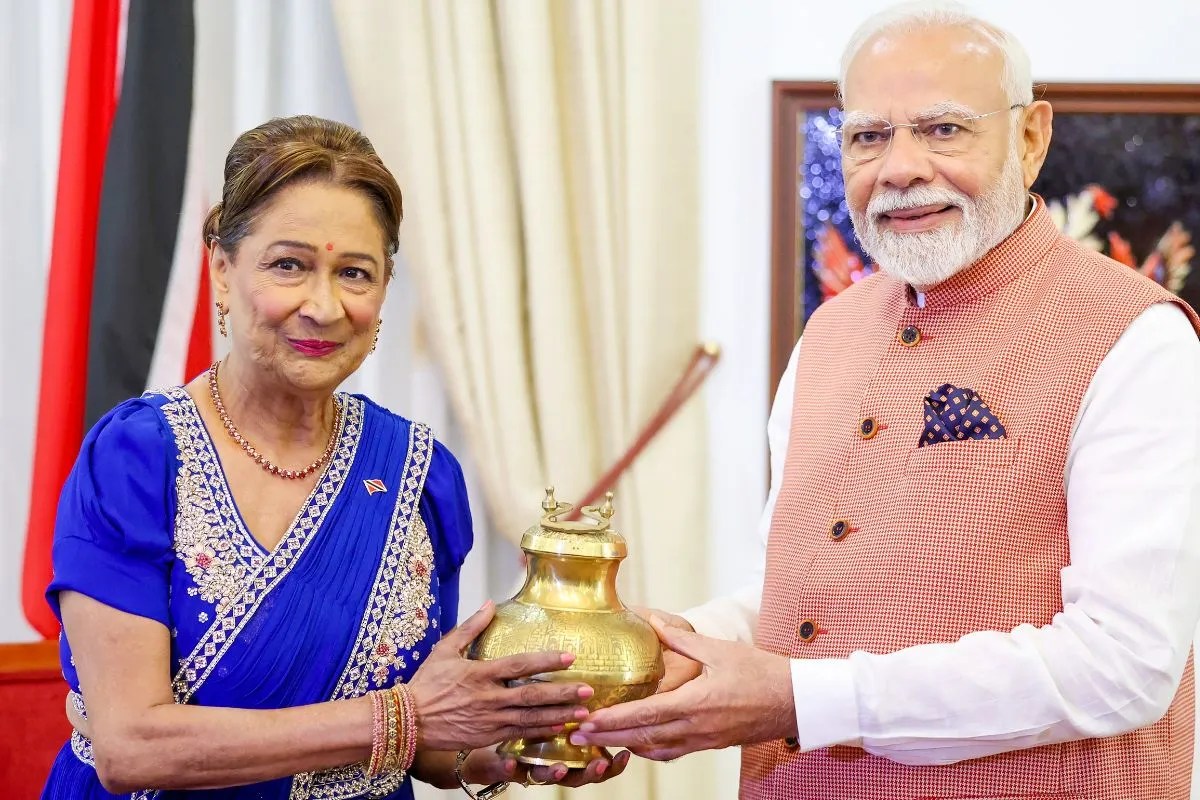
The trajectory of Navin Ramgoolam and the broader political evolution of Mauritius serves as a case study in the intersection of hereditary political capital and the dismantling of rigid socio-economic barriers. While populist narratives often focus on the emotional "rags-to-riches" arc—specifically referencing the lineage of leaders like Sir Seewoosagur Ramgoolam, whose father migrated as an indentured laborer (often colloquially termed a 'coolie')—this framing obscures the actual structural mechanics of power. The survival and dominance of this political lineage are not products of sentiment, but of a calculated mastery over three specific pillars: institutional capture, the strategic management of a multi-ethnic electorate, and the weaponization of the "meritocratic myth" to silence critics.
The Indentured Laborer Origin and the Capital Accumulation Cycle
The historical starting point of the Ramgoolam dynasty is rooted in the 19th-century British indentured labor system. To understand the transition from a manual laborer on a sugar plantation to the Premiership of a sovereign nation, one must examine the Capital Accumulation Cycle within the Indo-Mauritian diaspora.
- Phase 1: Labor for Land. The initial generation leveraged the petite morcellement—the process where sugar estates sold marginal lands to laborers. This converted physical toil into fixed assets.
- Phase 2: Educational Pivot. Financial surplus from land was redirected into high-yield human capital. Sir Seewoosagur Ramgoolam’s journey to study medicine in the UK was the definitive pivot point. It shifted the family’s value proposition from physical labor to intellectual and professional authority.
- Phase 3: Political Consolidation. Professional prestige provided the platform for labor advocacy, which eventually scaled into the leadership of the Mauritius Labour Party.
This progression demonstrates that the current Prime Minister’s position is not a spontaneous triumph over adversity, but the result of a multi-generational strategy designed to convert agrarian surplus into political hegemony.
Structural Resilience against Criticisms of Dynasty
Critics often target the dynastic nature of Mauritian politics, yet these critiques frequently fail because they ignore the Institutional Moat built by the Ramgoolam legacy. The legitimacy of the current leadership is reinforced by a "Social Contract of 1968," which tied the family name to the creation of the Mauritian welfare state.
This contract created a dependency model that functions through:
- Universal Healthcare and Education: By institutionalizing these services, the leadership effectively neutralized the primary pain points of the working class.
- The Best Loser System: The unique Mauritian electoral mechanism ensures ethnic representation. The Ramgoolam strategy has historically involved balancing this system to ensure that minority groups feel protected under a majority-led party, creating a broad-based coalition that is resistant to single-issue opposition.
Critics who focus on "nepotism" or "dynastic rule" are essentially fighting a psychological battle against a population that equates the dynasty with the existence of the middle class itself. To the average voter, the "Coolie's daughter/son" narrative is not a story of individual success, but a proxy for their own potential for upward mobility.
The Cost Function of Political Identity
Every political identity carries a maintenance cost. For a leader whose brand is built on the struggle of the laboring class, the primary risk is Elite Drift. This occurs when the lifestyle, policies, and associations of the leader become decoupled from the base.
To mitigate Elite Drift, the leadership employs a specific rhetorical framework: The Resilience Reflex. When faced with corruption allegations or policy failures, the narrative is shifted back to the ancestral struggle. By framing contemporary criticism as an attack on the "rights of the common man" or an "insult to the history of the laborers," the leadership successfully triggers a defensive tribal response. This redirects the analytical focus away from policy efficacy and toward historical grievance.
The Economic Transformation and Global Arbitrage
The current administration's success is increasingly dependent on its ability to transition from a sugar-and-textile economy to a sophisticated financial services hub. This requires a shift from "Laborer Politics" to "Arbitrage Politics."
- Tax Treaty Management: Utilizing Mauritius’s status as a gateway for FDI into India and Africa.
- Blue Economy Expansion: Leveraging the vast Exclusive Economic Zone (EEZ) for maritime resources.
- Digital Sovereignty: Investing in subsea cable infrastructure to reduce the cost of data.
The bottleneck here is the "Brains Drain." As the education system—built by the founders—produces high-skill graduates, the domestic market often fails to provide equivalent high-wage opportunities. The strategic failure of the current model is its inability to retain the very meritocratic talent it claims to champion. This creates a paradox: the leadership celebrates social mobility while the most mobile citizens are leaving the jurisdiction.
Deconstructing the "Critics Silence" Phenomenon
The claim that the Prime Minister gave a "fitting reply" to critics is rarely about the logic of the argument and more about the timing of economic delivery. In politics, silence is purchased through stability. The Mauritian model suggests that as long as the GDP per capita maintains a steady upward trajectory and the social safety net remains intact, ethical or dynastic concerns remain secondary to the electorate.
The "reply" mentioned in popular media is often a performance of Status Reversal. By invoking their humble origins in high-stakes diplomatic or political settings, these leaders perform a symbolic victory for their constituents. It is a psychological wage paid to the voters, reinforcing the idea that "one of us" is in the room where decisions are made.
The Strategic Forecast for Mauritian Governance
The future of this political model depends on its ability to navigate the transition from a post-colonial identity to a globalized service economy. The reliance on the "indentured laborer" narrative is reaching its expiration date as the younger generation—Gen Z and Millennials—lacks the lived memory of the pre-independence struggle.
To maintain dominance, the leadership must pivot from historical legitimacy to Operational Legitimacy. This involves:
- Dismantling the Patronage Network: Reducing the reliance on state-owned enterprises (SOEs) as employment agencies for political loyalists.
- Aggressive Tech Integration: Automating the bureaucracy to reduce the friction points that currently invite corruption.
- Climate Adaptation: As an island nation, the cost of rising sea levels is the single greatest threat to the long-term solvency of the Mauritian state.
The strategic recommendation for the Mauritian administration is to decouple the "Ramgoolam Brand" from historical grievance and re-anchor it in "Future-Proofing." The narrative of the "coolie’s descendant" has served its purpose in consolidating power; the next phase requires the leadership to act as a venture capitalist for the nation's human capital. Failure to make this shift will result in an irreconcilable gap between the ruling elite and a technocratic, globalized citizenry that values current performance over ancestral history.