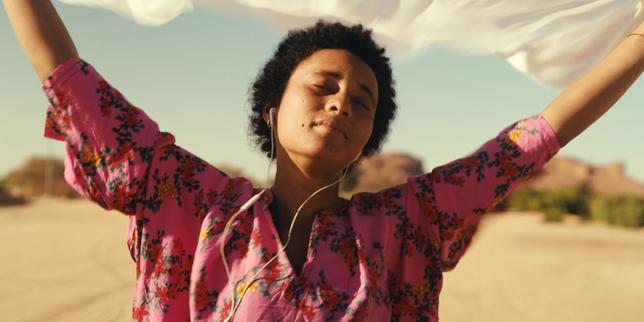
Mahamat-Saleh Haroun has never been a filmmaker interested in the easy aesthetics of tragedy. While much of the global cinematic output concerning the Sahel focuses on the grinding machinery of war or the desperation of migration, Haroun has spent decades carving out a space for the internal lives of Chadians. His latest work, Soumsoum, la nuit des astres, represents a sharp departure from the gritty realism of his previous award-winners like A Screaming Man or Lingui, The Sacred Bonds. This time, he has retreated to the Ennedi Plateau in northeastern Chad to film a fable that functions as a political manifesto hidden within a dream.
The film follows Soumsoum, a young woman navigating a society where tradition is often used as a blunt instrument for control. In the vast, silent stretches of the desert, she seeks a form of liberation that isn't found in fleeing to Europe, but in reclaiming the very ground beneath her feet. Haroun isn't just telling a story about a girl; he is documenting the friction between an ancient landscape and the modern desire for individual agency. Discover more on a similar topic: this related article.
The Architecture of Silence in the Ennedi
Most directors treat the desert as a void. Haroun treats it as a character with a long memory. The Ennedi Plateau, a UNESCO World Heritage site, provides more than just a backdrop of sandstone arches and hidden water pockets. It acts as a natural fortress where the rules of the city of N'Djamena feel distant and porous.
By choosing this specific location, Haroun taps into a regional identity that is often ignored by the central government. The people of the northeast have a historical reputation for independence and resistance. In Soumsoum, the landscape mirrors the protagonist’s internal state. The jagged rocks represent the obstacles of patriarchal expectations, while the open horizon suggests a freedom that is technically available but practically guarded by social sentinels. More analysis by Deadline delves into related views on this issue.
Haroun’s camera work in this film moves away from the handheld urgency of his earlier urban dramas. Instead, he uses wide, static shots that force the viewer to sit with the scale of the environment. You feel the heat. You sense the isolation. This stylistic choice emphasizes that for Soumsoum, "liberation" is not a fast-paced escape; it is a slow, deliberate reconstruction of her own identity.
A Subversive Use of Folk Tradition
The "fable" element of the film is where Haroun does his most sophisticated work. In many African cinematic traditions, the fable is used to teach a moral lesson that reinforces social cohesion. Haroun flips this. He uses the structure of a folktale to argue for social disruption.
Soumsoum’s journey involves a series of encounters that feel almost mythological. She meets figures who represent different facets of Chadian history—the warrior, the sage, the gatekeeper. However, instead of following the prescribed path these figures set out for her, she questions their authority. This is a radical act in a culture where respect for elders and tradition is the bedrock of social order.
The filmmaker is making a pointed critique of how "tradition" is frequently weaponized to keep women in a state of permanent adolescence. By framing this critique as a fable, Haroun bypasses the immediate defensiveness that a contemporary political drama might provoke. He is speaking in the language of the ancestors to tell the youth they have the right to change the conversation.
The Gendered Politics of the Night
A significant portion of the film takes place after dark. The title itself, La nuit des astres (The Night of the Stars), signals that the darkness is not a time of fear, but a time of clarity. In many conservative societies, the night is a restricted space for women. Their movements are monitored, and their presence outdoors after sunset is often viewed with suspicion.
Haroun reclaims the night for his protagonist. Under the stars, the social hierarchies of the daylight hours begin to dissolve. The desert at night becomes a space where Soumsoum can breathe without the weight of the male gaze. The cinematography during these sequences is breathtaking, using natural light sources—fire, moonlight—to create an atmosphere that feels both ancient and immediate.
This isn't just a visual trick. It’s a statement on the necessity of "shadow spaces" for marginalized groups. If the daylight belongs to the law and the patriarch, then the night belongs to the dreamer and the rebel.
Why Chad’s Cinema Infrastructure Still Struggles
While Soumsoum will likely find a home on the international festival circuit—from Cannes to FESPACO—the reality for filmmakers inside Chad remains bleak. Haroun is the undisputed titan of Chadian cinema, yet he often has to look toward French co-productions to secure the budgets his visions require.
The lack of domestic distribution means that most Chadians will never see Soumsoum on a big screen. The historic "Le Normandie" cinema in N'Djamena has struggled for years, and while there have been sporadic efforts to revive the national film board, the political instability of the region often pushes cultural funding to the bottom of the priority list.
This creates a strange paradox. Haroun’s films are the primary way the world sees Chad, yet the very people he depicts are often excluded from the viewing experience. Soumsoum addresses this indirectly by focusing on the oral tradition. Haroun knows his stories will travel through word of mouth, becoming part of the modern folklore of the country even if the physical film reels never reach the remote villages of the Ennedi.
Breaking the Cycle of Victimhood
For years, African cinema was dominated by the "social realist" school, which often portrayed characters as victims of systemic forces—poverty, colonialism, or disease. Haroun was a part of this movement, but his work has evolved. Soumsoum is an example of what some critics are calling "Sahelian Afrofuturism," though Haroun might reject such a trendy label.
He is interested in the power of the imagination. Soumsoum does not win by defeating an army; she wins by refusing to believe in the limitations placed upon her. This is a much harder victory to depict on screen, but it is far more resonant for a young generation of Chadians who are tired of being defined by their country's GDP or its conflict history.
The film suggests that true power lies in the ability to name one's own reality. When Soumsoum looks at the stars, she isn't looking for a way out; she is looking for a way in—into a version of Chad that allows for her existence as a free, thinking individual.
The Technical Rigor of the Desert Shoot
Filming in the Ennedi is a logistical nightmare. The heat can reach levels that cause digital sensors to fail, and the blowing sand is an enemy to every piece of glass on a camera. Haroun’s crew, many of whom have worked with him for decades, had to operate with a lean, mobile setup.
This forced simplicity actually benefits the film. There are no flashy visual effects or over-the-top set pieces. Everything feels tactile. When a character touches a rock, you hear the grit. When the wind blows, it isn't a studio sound effect; it’s the actual atmosphere of the Sahara.
This authenticity is what prevents Soumsoum from becoming a "poverty porn" travelogue. It is a rigorous piece of filmmaking that respects the environment it depicts. Haroun avoids the "National Geographic" style of cinematography that tends to exoticize the African landscape. Instead, he treats the Ennedi with the same boring familiarity a New York director might treat a subway station. It is home, with all the beauty and frustration that word implies.
A Master at the Height of His Powers
Haroun is now in a position where he no longer has to prove his technical competence. He is a master of the form. This allows him to take risks that younger directors might shy away from. Soumsoum is a slow film. It demands patience. In an era of three-second cuts and relentless pacing, Haroun’s insistence on the long take is a defiant act.
He is betting that the audience is willing to slow down and enter the rhythm of the desert. He is betting that the story of one woman’s quiet rebellion is enough to sustain two hours of cinema. For the most part, he is right. The film lingers in the mind long after the final frame, not because of a shocking plot twist, but because of the sheer weight of its atmosphere.
The film ends not with a grand resolution, but with a beginning. Soumsoum is still in the desert. The challenges of her society haven't vanished overnight. But she is standing differently. Her shoulders are back. She has seen the stars, and she knows that the world is much larger than the village she was born in.
Haroun has given us a map of the Chadian soul, one that doesn't shy away from the shadows but insists on the light. The Ennedi Plateau remains as it has been for millennia, but through Soumsoum’s eyes, it has been transformed from a cage into a springboard. This is the function of the modern fable: to take the oldest stories we know and use them to break the newest chains we wear.
Invest in the slow burn of the narrative and look past the surface-level beauty of the Ennedi. The real story is the silent revolution happening in the eyes of a woman who has decided that she is no longer afraid of the dark.