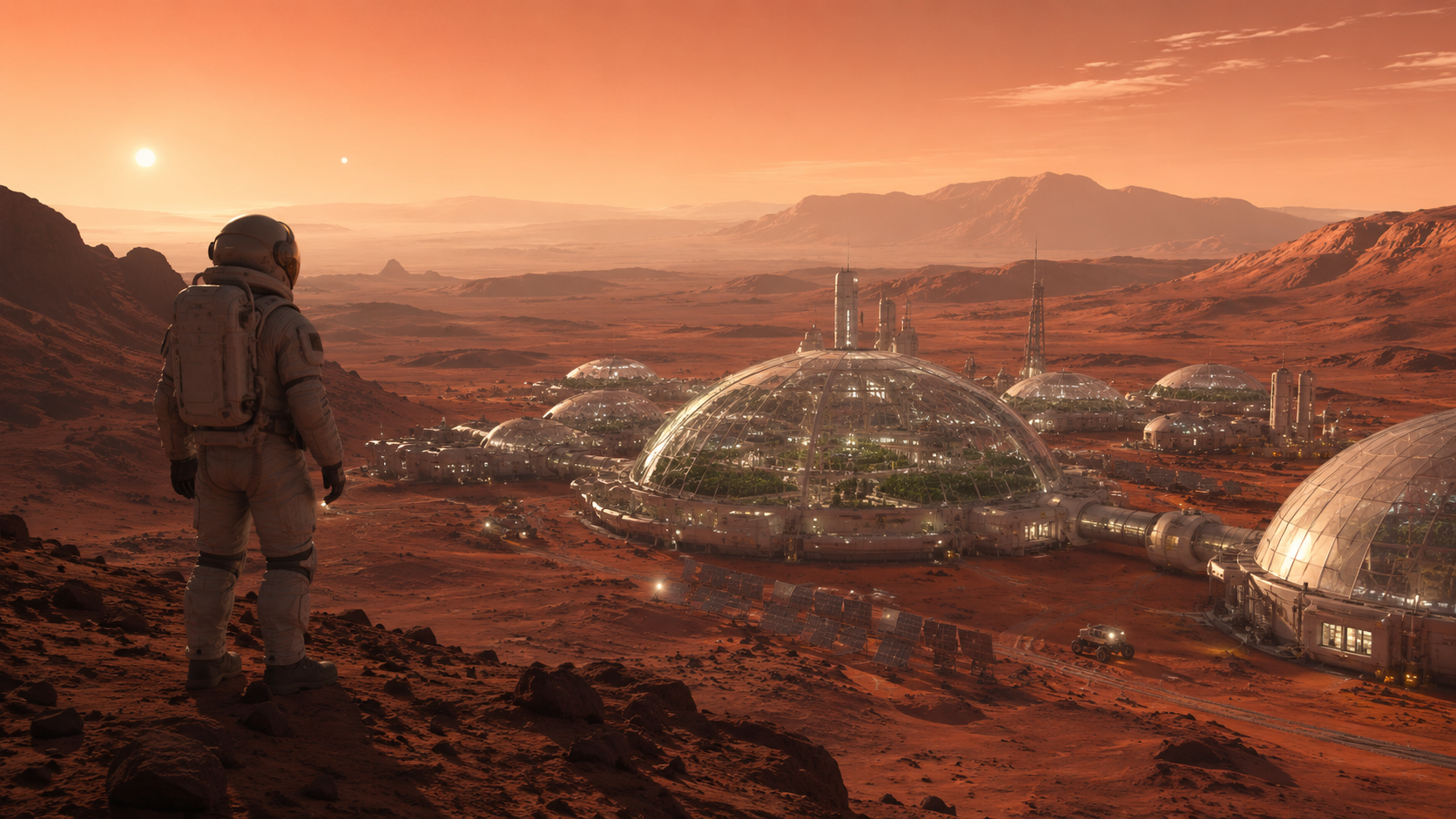
The ambition to establish a self-sufficient human presence on Mars rests on a fundamental misunderstanding of systemic entropy and the minimum viable scale of modern industrial civilization. While public discourse focuses on propulsion physics and radiation shielding, the terminal bottleneck is not the transit to Mars but the insurmountable complexity of replicating the terrestrial supply chain in a resource-scarce, vacuum-adjacent environment. True self-sufficiency requires a closed-loop system that can maintain high-technology hardware without a single input from Earth—a goal that currently lacks a credible engineering pathway.
The Taxonomy of Martian Dependency
Self-sufficiency is often conflated with "survivability." A colony that can produce oxygen and water is merely surviving; a self-sufficient colony must be able to manufacture the machines that produce oxygen and water. This creates a recursive dependency loop. To define the scale of the challenge, we must categorize the requirements into three distinct tiers of industrial autonomy.
Tier 1 Primary Extraction and Life Support
This level involves the conversion of Martian regolith and atmosphere into consumables.
- Atmospheric Processing: Utilizing the Sabatier reaction to produce oxygen and methane ($CH_4$) from $CO_2$ and imported or locally mined hydrogen.
- Hydrological Mining: Extracting water ice from mid-latitude subsurface deposits.
- Caloric Production: Establishing hydroponic or aeroponic systems capable of meeting the metabolic demands of a crew.
While these technologies exist in laboratory settings, they represent the easiest 1% of the total problem. They solve for biological survival but do not address the degradation of the hardware performing these tasks.
Tier 2 Component Maintenance and Manufacturing
This is where the math of Martian colonization begins to fail. On Earth, a simple water pump is the product of a globalized supply chain involving specialized alloys, precision bearings, and synthetic seals.
- The Precision Gap: Mars lacks the "industrial sourdough" required to jumpstart manufacturing. You cannot build a 3D printer capable of printing high-precision CNC mill parts from raw Martian dust without first having a high-precision CNC mill.
- Material Science Constraints: Creating semiconductors, specialized lubricants, and radiation-hardened polymers requires chemical precursors and extreme-environment facilities that do not scale down effectively. Earth’s semiconductor industry relies on a global volume of trillions of dollars to remain viable; Mars will have a "market" of a few hundred people.
Tier 3 Total Industrial Closure
The final stage is the ability to mine, smelt, refine, and manufacture every single component of the colony’s infrastructure from scratch. This requires a "Minimum Viable Population" (MVP) for an industrial base. Estimates for a modern industrial MVP range from 100,000 to 1,000,000 specialized workers. Anything less results in "technological regression," where the colony gradually loses the ability to maintain its most advanced systems as they break down.
The Cost Function of Low Gravity and High Radiation
The environmental variables of Mars impose a continuous tax on every physical system, accelerating the rate of entropy and increasing the frequency of the "Maintenance Trap."
Atmospheric Leakage and Seal Failure
Mars has roughly 1% of Earth's atmospheric pressure. This creates a permanent pressure differential that forces gases out of every possible microscopic orifice. In engineering terms, seals are consumable items. On Earth, a failed seal is a nuisance; on Mars, it is a localized catastrophe. The colony must have the capacity to synthesize complex elastomers and polymers locally, or it will slowly suffocate as its gas reserves bleed into the vacuum.
The Low-Gravity Biological Tax
Human physiology is optimized for 1g. The 0.38g environment of Mars triggers bone density loss, muscular atrophy, and fluid shifts that affect ocular pressure and neurological function.
- Medical Self-Sufficiency: A self-sufficient city must provide advanced medical care, including surgery and pharmaceutical synthesis, in low gravity.
- The Genetic Bottleneck: Long-term habitation requires successful multi-generational reproduction. We currently have zero data on whether a human embryo can develop correctly in 0.38g. If it cannot, "self-sufficiency" is biologically impossible, as the colony would require a constant influx of Earth-born humans to maintain its population.
The Fragility of Localized Energy Grids
A Martian city cannot rely on fossil fuels or easy combustion. It is limited to nuclear fission or solar power, both of which present massive logistical hurdles for a closed-loop system.
Solar Limitations
Mars receives roughly 43% of the sunlight Earth does. Furthermore, periodic global dust storms can last for months, reducing solar flux to near zero. A solar-dependent colony must therefore possess a massive energy storage capacity—likely in the form of hydrogen fuel cells or advanced batteries.
- The Chemical Lifecycle: Batteries have a finite number of cycles. Without a local factory capable of refining lithium or cobalt and manufacturing electrodes, the colony’s power grid has a hard expiration date.
Fission Dependencies
Nuclear power offers high energy density and reliability. However, it requires enriched uranium or thorium. While these elements may exist on Mars, the industrial infrastructure required to find, mine, and enrich them is equivalent to the complexity of a medium-sized nation-state on Earth. A colony that relies on fuel rods shipped from Earth is a subsidized outpost, not a city.
The Software and Silicon Bottleneck
The most significant overlooked barrier is the "Silicon Ceiling." Modern life-support, navigation, and communication systems run on microprocessors with transistor gates measured in nanometers.
The Photolithography Problem
Manufacturing a 5nm or even a 28nm chip requires extreme ultraviolet (EUV) lithography machines that are among the most complex devices ever built. They are produced by a single company (ASML) using components from thousands of global suppliers.
- Hardware Decay: Ionizing radiation on Mars causes "bit flips" and physical damage to silicon over time.
- The Replacement Paradox: If a colony cannot manufacture its own chips, its entire digital nervous system is on a countdown to failure. Unlike a hammer or a brick, a microprocessor cannot be "blacksmithed" in a frontier environment.
The Economic Reality of Galactic Isolation
For a city to be self-sufficient, it must be economically viable. It needs a reason to exist that justifies the massive energetic cost of its own maintenance.
- Lack of Exportable Value: Mars has no unique physical resource that is more cost-effective to mine and ship to Earth than to find on Earth or in the asteroid belt.
- Knowledge as Currency: The only viable export is intellectual property or data. However, the lag time in communication (up to 20 minutes one-way) prevents Mars from participating in real-time global markets.
- The Subsidy Trap: As long as Earth provides the "high-entropy" goods (chips, medicines, specialized alloys), the Martian colony is effectively a high-cost research station. To break the subsidy, the colony must increase its population to reach the industrial MVP, but increasing the population exponentially increases the demand for the very goods it cannot yet produce.
Structural Bottlenecks in Resource Synthesis
The assumption that "In-Situ Resource Utilization" (ISRU) solves the problem ignores the energy-to-mass ratio. To produce one ton of usable steel or plastic on Mars requires significantly more energy than on Earth due to the lack of concentrated biological precursors (like oil) and the oxidation state of Martian minerals.
- The Carbon Deficit: While $CO_2$ is plentiful, converting it into structural polymers requires massive amounts of hydrogen. If water ice mining underperforms, the carbon remains trapped in gaseous form.
- The Phosphorus Problem: Earth's agriculture relies on concentrated phosphate deposits. We have yet to identify accessible, high-concentration phosphorus sources on Mars. Without it, the "self-sufficient" food loop collapses within a few harvest cycles as the initial nutrient load is depleted.
The Strategic Path Forward
The goal of a self-sufficient Mars city is currently a theoretical impossibility based on our existing industrial and biological models. To move toward viability, the strategy must shift from "colonization" to "autonomous industrialization."
The first priority is not sending humans, but sending self-replicating or highly autonomous robotic systems designed to build the "Industrial Sourdough"—the machines that make the machines. Until we can demonstrate the ability to manufacture a simple integrated circuit or a high-pressure hydraulic pump using 100% non-terrestrial inputs, any human presence on Mars will remain a fragile extension of Earth's biosphere, utterly dependent on a supply chain that spans 140 million miles of vacuum. The metric of success is not the first footprint, but the first Martian factory that does not require a spare part from Earth.
The focus must remain on perfecting closed-loop chemical engineering and micro-scale manufacturing long before the first permanent foundation is poured in the Martian regolith. Failure to solve the industrial closure problem ensures that any Martian "city" will eventually become a graveyard of high-tech relics.