The report of 33,000 Russian drones neutralized by Ukrainian forces in a single month signifies a fundamental shift in the economics of modern siege warfare. This figure—a record-shattering volume—indicates that the conflict has moved beyond the "tactical integration" phase of unmanned aerial systems (UAS) and into a state of industrial-scale kinetic saturation. To understand the implications of these numbers, one must look past the headline and analyze the structural mechanics of mass-scale drone deployment, the cost-asymmetry of interception, and the saturation threshold of electronic warfare (EW) environments.
The Triad of Drone Proliferation
The surge to 33,000 neutralized units suggests an underlying deployment rate that likely exceeds 40,000 to 50,000 total launches when factoring in successful strikes and technical failures. This volume is sustained by three distinct supply-chain pillars: If you enjoyed this piece, you might want to look at: this related article.
- State-Sponsored Strategic Munitions: These are high-end platforms like the Shahed-series (Geran-2), designed for long-range strikes against energy infrastructure. While they represent the smallest percentage of the 33,000 count, they consume the largest share of air defense resources.
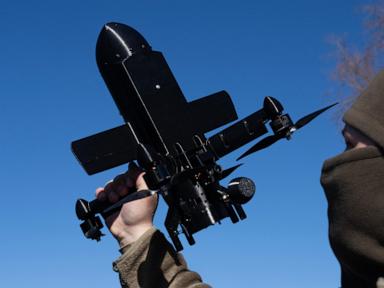
- Commercial-Off-The-Shelf (COTS) FPV Conversions: The vast majority of the "record" is comprised of First-Person View (FPV) racing drones modified to carry RPG-7 warheads or plastic explosives. These are cheap ($400–$600), ubiquitous, and deployed as "disposable artillery" at the platoon level.
- Experimental and DIY Reconnaissance Units: Small, short-range quadcopters used for real-time spotting and battle damage assessment (BDA).
The Mechanics of Neutralization
The term "shot down" is a linguistic simplification that masks a complex hierarchy of defensive measures. In a high-intensity electronic environment, neutralization occurs through three primary vectors:
1. Hard Kill (Kinetic Interception)
This involves physical destruction via anti-aircraft guns (Gepard, ZU-23-2) or shoulder-fired missiles (MANPADS). On a volume of 33,000 units, relying solely on kinetic interception is an economic impossibility. A $20,000 Mistral missile fired at a $500 FPV drone represents a negative ROI of 4,000%. Consequently, the Ukrainian success rate relies heavily on high-cadence, low-cost barrel-based systems and, increasingly, "interceptor drones" that ram incoming threats. For another look on this development, check out the recent update from The Washington Post.
2. Soft Kill (Electronic Warfare)
The most scalable method for handling 1,000+ drones per day is "soft-kill" electronic interference. This involves:
- GPS Spoofing: Overriding the drone’s navigation system with false coordinates to force it to land or crash.
- Command Link Jamming: Severing the radio frequency (RF) connection between the pilot and the craft.
Once the link is severed, most FPV drones either hover until their battery dies or drift aimlessly.
3. Kinetic-EW Synergy
Modern defensive nodes now utilize a "detect-and-disrupt" loop. Passive RF sensors detect the specific frequency of a drone’s telemetry; an EW jammer then forces the drone into a predictable flight path (or a hover), making it an easy target for small arms fire. The 33,000 figure is a testament to the maturation of this integrated defensive grid.
The Cost Function of Saturation
In traditional warfare, an attacker achieves "saturation" when they fire more projectiles than the defender has interceptors. In the context of 33,000 drones, Russia is attempting to find the Defensive Break-Even Point.
$C_{def} = (n \times P_{int}) + (h \times C_{res})$
Where:
- $C_{def}$ is the total cost of defense.
- $n$ is the number of drones.
- $P_{int}$ is the price of the interceptor.
- $h$ is the human capital required for 24/7 monitoring.
- $C_{res}$ is the resource cost of operating EW equipment.
As $n$ reaches 33,000, the cost of $P_{int}$ must trend toward zero to prevent a total depletion of the defender's budget. This explains Ukraine’s pivot toward "Mobile Fire Groups"—pickups equipped with machine guns and thermal optics—which provide a near-zero marginal cost per intercept compared to sophisticated Western missile systems.
The Feedback Loop of Industrial Attrition
The record-breaking numbers indicate an evolved "cat and mouse" cycle in the RF spectrum. When Russia deploys a new frequency for their drones, intercept numbers initially dip. Once Ukrainian engineers identify the new frequency and update their EW "bubbles," the intercept numbers spike. The 33,000 figure likely represents a period where Ukrainian EW capabilities were perfectly tuned to the current Russian drone configurations.
However, this creates a Frequency Bottleneck. There is a finite amount of usable spectrum for controlling drones. As the air becomes increasingly crowded with both friendly and hostile signals, "electronic fratricide" becomes a risk, where a side's own EW systems inadvertently ground their own drones.
Structural Limitations of the Data
While 33,000 is a staggering metric, it remains a "vanity metric" unless correlated with two missing variables:
- The Leakage Rate: How many drones missed their targets but were not shot down? If 33,000 were downed but 10,000 hit their targets, the operational impact remains severe.
- The Inventory Depletion Rate: Does Russia have the manufacturing capacity to sustain 30,000+ losses per month? Estimates of Russian domestic production, supplemented by Iranian components and Chinese COTS parts, suggest that while they can produce thousands, 33,000 losses per month puts them in a state of net-negative inventory.
The Evolution toward Autonomous Terminal Guidance
The immediate response to high interception rates is the removal of the human in the loop. We are seeing the transition from RF-controlled drones to those equipped with Optical Flow and Edge AI.
In this configuration, a drone uses a simple onboard processor to recognize a tank or a trench. Once the pilot gets the drone within a few hundred meters, they "lock" the target, and the drone completes the strike autonomously. Because it no longer requires an RF link for the final 200 meters, traditional EW jamming becomes useless. This technological pivot will likely render the "soft-kill" methods responsible for much of the 33,000-count obsolete within the next six to twelve months.
To maintain this defensive dominance, the strategic imperative shifts from EW jamming to Directed Energy Weapons (DEW) and high-power microwaves (HPM). These systems do not rely on frequency interference; instead, they fry the drone’s internal circuitry with a burst of concentrated energy. The transition to DEW is not a luxury but a mathematical necessity to counter the move toward autonomous, non-RF-reliant loitering munitions.
The defender must now prioritize the deployment of short-range, high-cadence automated turrets capable of processing multiple targets per second. The era of the human-aimed machine gun is closing; the 33,000-drone month is the final signal that the battlefield is now an automated competition between two competing industrial algorithms.