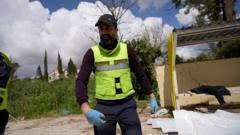
The "triple-tap" strike—a sequence of repeated aerial or artillery bombardments on a single coordinate within a narrow temporal window—represents the terminal point of tactical efficiency at the expense of international legal norms. When such a sequence targets medical personnel, as reported in the recent engagement in Lebanon involving three paramedics, it signals a shift from collateral damage to the systematic degradation of the humanitarian ecosystem. This isn't merely a tragedy of timing; it is an operational outcome of a specific military logic that prioritizes the total denial of casualty recovery over the traditional protections afforded by the Geneva Conventions.
The Mechanics of the Triple-Tap Sequence
The triple-tap is a refinement of the "double-tap" tactic, designed to maximize the lethality of a strike by targeting the first responders who arrive at the scene of an initial blast. The logic follows a three-stage kill chain:
- The Kinetic Anchor: An initial strike targets a high-value individual, facility, or asset. This creates the site of engagement and triggers the emergency response protocol.
- The Response Interdiction: A second strike occurs several minutes later, specifically timed to coincide with the arrival of medical teams and recovery units. The goal is to neutralize the "force multiplier" of medical care.
- The Area Denial: A third strike secures the perimeter through fire, preventing any subsequent extraction of survivors or the recovery of the bodies of the first responders.
In the context of the Lebanese border, these strikes function as a psychological deterrent. By targeting paramedics, the striking force raises the "entry cost" for humanitarian aid to a level that threatens to collapse the local civil defense infrastructure. This creates a vacuum of care that accelerates the displacement of the civilian population.
The Categorization of Risk in Contested Zones
To understand why paramedics are increasingly caught in this kinetic loop, we must categorize the variables that define their risk profile. The survival of medical personnel in a high-intensity conflict zone depends on the stability of three distinct pillars:
Identification and Technical Visibility
International law requires medical units to be clearly marked. However, in modern electronic warfare environments, visual markers like the Red Cross or Red Crescent are often secondary to the digital footprint. If a paramedic unit utilizes unencrypted radio frequencies or GPS-enabled devices that are monitored by an adversary's signals intelligence (SIGINT), their "protected status" becomes a data point in a targeting algorithm. The failure here is often a mismatch between humanitarian transparency and military surveillance capabilities.
The Proximity Variable
Modern urban warfare blurs the line between combatants and non-combatants. When medical outposts are situated within a hundred meters of rocket launch sites or command nodes, the probability of "precision errors" increases exponentially. The logic of the striker often dictates that the presence of a military asset nullifies the protected status of the adjacent medical facility.
Strategic Intent of the Belligerent
We must distinguish between accidental strikes and "targeted attrition." Accidental strikes are the result of faulty intelligence or mechanical failure. Targeted attrition, however, is a deliberate policy where the destruction of the adversary's social support system—including hospitals and ambulances—is viewed as a necessary step to force a surrender. The use of a triple-tap suggests the latter, as the probability of three consecutive strikes hitting the same non-combatant target by accident is statistically negligible.
The Cost Function of Humanitarian Neutrality
Neutrality is not a passive state; it is an expensive operational requirement. The cost of maintaining neutrality in the Lebanon-Israel theater has shifted from a diplomatic burden to a life-safety risk.
The Humanitarian Cost Function can be modeled by the relationship between:
- Operational Reach: How far into a "red zone" a paramedic can travel.
- Targeting Latency: The time it takes for an adversary to re-acquire and strike a target.
- Protection Deficit: The gap between international legal protections and the physical armor available to the responder.
As targeting latency drops due to drone persistence (loitering munitions), the protection deficit widens. Paramedics in Lebanon are operating in an environment where the "window of safety"—the time between an event and a follow-up strike—has shrunk to near zero.
Structural Failures in Deconfliction Protocols
The deaths of these paramedics highlight a systemic breakdown in deconfliction. Deconfliction is the process by which NGOs and medical agencies share their coordinates with warring parties to avoid being targeted. Several factors are currently undermining this system:
- Asymmetric Data Integrity: One side may provide coordinates, but the other side may not integrate that data into their active targeting software in real-time.
- The "Dual-Use" Justification: Belligerents often claim that ambulances are being used to transport weapons or fighters. Whether true or not, the mere assertion of dual-use is used to bypass the legal immunity of the vehicle.
- Algorithmic Bias: In high-speed conflict, much of the initial target identification is done by AI-driven systems that prioritize "patterns of life." A group of people rushing toward a blast site can be algorithmically flagged as "reinforcements" rather than "rescuers."
The Erosion of the "Sanctity of the Wound"
The fundamental principle of medical ethics in war is the "sanctity of the wound"—once a person is incapacitated, they are no longer a combatant, and those treating them are sacrosanct. The triple-tap strike is the physical manifestation of the rejection of this principle.
When a state actor employs these tactics, they are making a calculated bet that the military advantage of killing first responders outweighs the diplomatic fallout of violating the Geneva Conventions. In the current geopolitical climate, where international enforcement mechanisms are fragmented, this bet often pays off. The "cost" of killing a paramedic is currently lower than the perceived "benefit" of ensuring a target does not survive.
Tactical Realignment for Medical NGOs
Given the reality of the triple-tap, medical organizations operating in southern Lebanon must move beyond reliance on "protected status" and adopt a defensive posture usually reserved for military units. This involves:
- Dispersed Staging: Never clustering multiple ambulances or teams at a single rally point.
- Asynchronous Response: Delaying the secondary wave of responders until the airspace is confirmed clear of loitering munitions, despite the medical cost of the delay.
- Digital Silence: Total emission control (EMCON) during transit to prevent SIGINT-based targeting.
The era of the "visible paramedic" is ending. If medical teams continue to operate under the assumption that their markings provide a "kinetic shield," their casualty rates will continue to climb.
The Strategic Path Toward Re-establishing Red Lines
To stop the normalization of the triple-tap, the international community must shift from "condemnation" to "consequence." This requires a two-track approach.
First, the evidentiary requirements for "dual-use" claims must be heightened. If a state strikes an ambulance, the burden of proof must immediately shift to that state to provide high-resolution, unedited sensor footage justifying the strike. Silence or delayed "investigations" must be treated as an admission of a war crime by default.
Second, the technical architecture of deconfliction must be modernized. We need a "Humanitarian Transponder"—a hardened, tamper-proof device that broadcasts a universally recognized "protected" signal on military frequencies, making it impossible for a pilot or drone operator to claim they didn't know the target was medical.
The current trajectory suggests that without these interventions, the medical corps will be fully absorbed into the list of "legitimate" targets in sub-conventional warfare. The triple-tap isn't just a tactical choice; it is a rewrite of the rules of engagement. Reversing it requires making the tactical cost of the strike—via sanctions, legal prosecution, and technological hurdles—higher than the perceived military gain. Organizations on the ground should immediately move to "black-site" medical operations, treating every extraction as a high-risk infiltration rather than a protected humanitarian mission. Confidence in the "Red Cross" as a shield is currently a liability. Only by operating with the tactical stealth of a combatant can the modern paramedic survive the logic of the triple-tap.