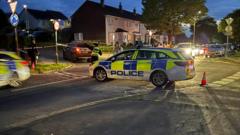
The tea was still steaming on Arthur’s kitchen table when the knock came. It wasn’t a polite, neighborly tap. It was the rhythmic, authoritative thud of a fist that knows it is about to change someone’s day.
Outside, the street in Plymouth looked exactly as it had for the last fifty years. Rows of terraced houses, their brickwork softened by the salt air, stood in silent formation. But the young police officer on the doorstep wasn't looking at the architecture. He was looking at his watch, and then at the 400-meter radius mapped out on his digital tablet.
"You need to leave, sir. Now. Take your essentials. We don’t know how long it will be."
Arthur didn't ask why. He already knew. In this part of the world, the ground has a long memory. For eight decades, a silent visitor had been cradled in the damp earth of a backyard just a few doors down. It was a leftover from a Tuesday night in 1941, a thousand-kilogram gift from the Luftwaffe that had failed to deliver its message on schedule.
We walk over history every day, assuming the ground is a static foundation. We trust the dirt. But beneath the hydrangeas and the weathered sheds of suburban Britain, thousands of high-explosive shadows remain. They are the "unexploded ordnance," or UXO—a clinical term for a mechanical heart that might decide to beat again at any moment.
The Physics of a Sleeping Giant
To understand the scale of what was happening in that 400-meter exclusion zone, you have to look past the rusted casing. Imagine a vintage car buried in the mud. Over eighty years, the steel thins. The acids in the soil chew at the fuse. Inside, the main filling—likely Amatol or TNT—remains chemically potent. It doesn't "expire" like milk; it waits.
A 500kg SC500 bomb, a common find in these coastal raids, contains enough energy to erase a city block. When the bomb disposal experts—the "Sappers"—arrive, they aren't just looking at a piece of scrap metal. They are looking at a complex, failing machine. The fuse might be a Type 15, a mechanical clockwork device, or a Type 17, which uses a glass vial of acetone to dissolve a celluloid disk. If that vial cracked eighty years ago and the disk is held by a single, thinning fiber, a vibration from a passing lorry or the clumsy strike of a builder’s spade is all it takes to complete the circuit.
This is the invisible stake of the evacuation. The 400-meter line isn't arbitrary. It is a calculation of blast pressure and fragmentation distance. It is the distance at which the air itself becomes a hammer, capable of shattering lungs and windows alike.
The Human Radius
By noon, the neighborhood had transformed. The mundane ritual of a Tuesday morning—laundry on the line, cars being washed—was replaced by the eerie silence of a ghost town.
Consider Sarah, who lives at the 350-meter mark. She had to gather her two toddlers, a diaper bag, and a confused golden retriever into the back of a hatchback within twenty minutes. The panic isn't the screaming kind; it's the quiet, vibrating kind. It’s the realization that your home, the place where you feel most secure, has suddenly become a "target area."
"I forgot the chargers," she told me later, sitting in a plastic chair at the local leisure center turned evacuation hub. "It sounds stupid. But you think about the things you need for a few hours, and then you realize that if that thing goes off, there won't be a wall to plug a charger into anyway."
This is the psychological tax of living in a post-conflict zone that never quite finished its conflict. We think of the Blitz as a series of black-and-white newsreels, a closed chapter of the 20th century. But for the people of Plymouth, Coventry, or London, the war is a subterranean roommate. It is a debt that hasn't been fully paid.
The evacuation of nearly 3,000 people creates a sudden, forced community of the displaced. In the leisure center, social barriers dissolve. The CEO sits next to the pensioner; the student shares a biscuit with the bus driver. They are all united by a single, terrifying variable: a hunk of German iron buried in a garden on St. Michael’s Avenue.
The Chemistry of Risk
While the families wait for updates on their phones, a team of Royal Navy divers and Army engineers are doing the most dangerous job in the country. They are standing in a muddy hole, inches away from a trigger that has been primed for 30,000 days.
Their first task is identification. They brush away the soil with the tenderness of archaeologists, looking for the markings on the fuse pocket. They have to decide: do we defuse it here, or do we move it?
Moving it is a nightmare of logistics. It requires a "sandcastle"—a massive structure of sandbags and water-filled containers designed to direct the blast upward rather than outward if the worst happens. Defusing it is a high-stakes game of chemistry and nerves. Sometimes, they use a technique called "cryogenic freezing," where liquid nitrogen is used to stall the chemical reactions inside the fuse. Other times, they use a remote-controlled laser or a high-pressure water cutter to slice through the casing without generating heat.
The tension is thick. Every minute the bomb remains in the ground, the risk profile shifts. Rain can soften the soil and cause the heavy casing to shift, putting pressure on a sensitive fuse. The Sappers move with a deliberate slowness that feels agonizing to the thousands of people waiting in school halls and hotel lobbies.
Why Now?
People often ask why these bombs are only appearing now. Surely, after eighty years, we should have found them all?
The answer lies in the way we use our land. Post-war reconstruction was often rushed. Rubble was cleared, holes were filled, and new houses were slapped down on top of craters. Many of these "duds" buried themselves ten or twenty feet deep into the soft clay, leaving only a small entry hole that was easily missed in the chaos of a burning city.
As we renovate our aging infrastructure—replacing Victorian sewers, digging foundations for home extensions, or installing heat pumps—we are essentially poking the dragon. We are interacting with a layer of the Earth that has been undisturbed since the 1940s.
It’s a sobering thought. Our modern lives are built on a crust of history that is still chemically active. We are the beneficiaries of a peace that was never quite absolute.
The Echo in the Silence
The sun began to set, casting long shadows over the empty streets. The exclusion zone remained. The police cordons held firm.
For the evacuees, the evening brought a strange kind of reflection. When you are told you might lose everything in a flash of light, your perspective narrows sharply. The "essentials" you grabbed—the photo albums, the cat, the legal papers—become the only things that matter. The rest is just lumber.
There is a specific kind of silence that falls over a neighborhood under threat. It’s not the peaceful silence of a park at dawn. It’s the expectant silence of a held breath. Every distant car backfire, every heavy thud of a closing door in the distance makes people jump.
We live in an era of digital threats, of cyber-warfare and invisible viruses. There is something profoundly jarring about a threat that is so physical, so heavy, and so old. It is a reminder that the past is never truly gone; it is just waiting for someone to dig a little too deep.
Late that night, word filtered through that the engineers had successfully neutralized the fuse. The "all clear" wouldn't come for a few more hours—the bomb still had to be carefully lifted and transported to a safe location for a controlled detonation at sea—but the immediate shadow had lifted.
Arthur returned to his kitchen. His tea was cold. The surface of the liquid was still, reflecting the light of his overhead lamp. He looked out the window at his small garden, at the patch of grass where he usually sat on Sunday afternoons. He thought about the weight of the earth, and the secrets it keeps, and how thin the line is between a normal Tuesday and a headline.
The bomb was gone, hauled away in a convoy of armored trucks, destined to become a muffled thump in the English Channel. But the ground in Plymouth felt different now. It felt less like a foundation and more like a veil.
History isn't a book on a shelf. It’s the thing beneath your feet, breathing quietly in the dark.