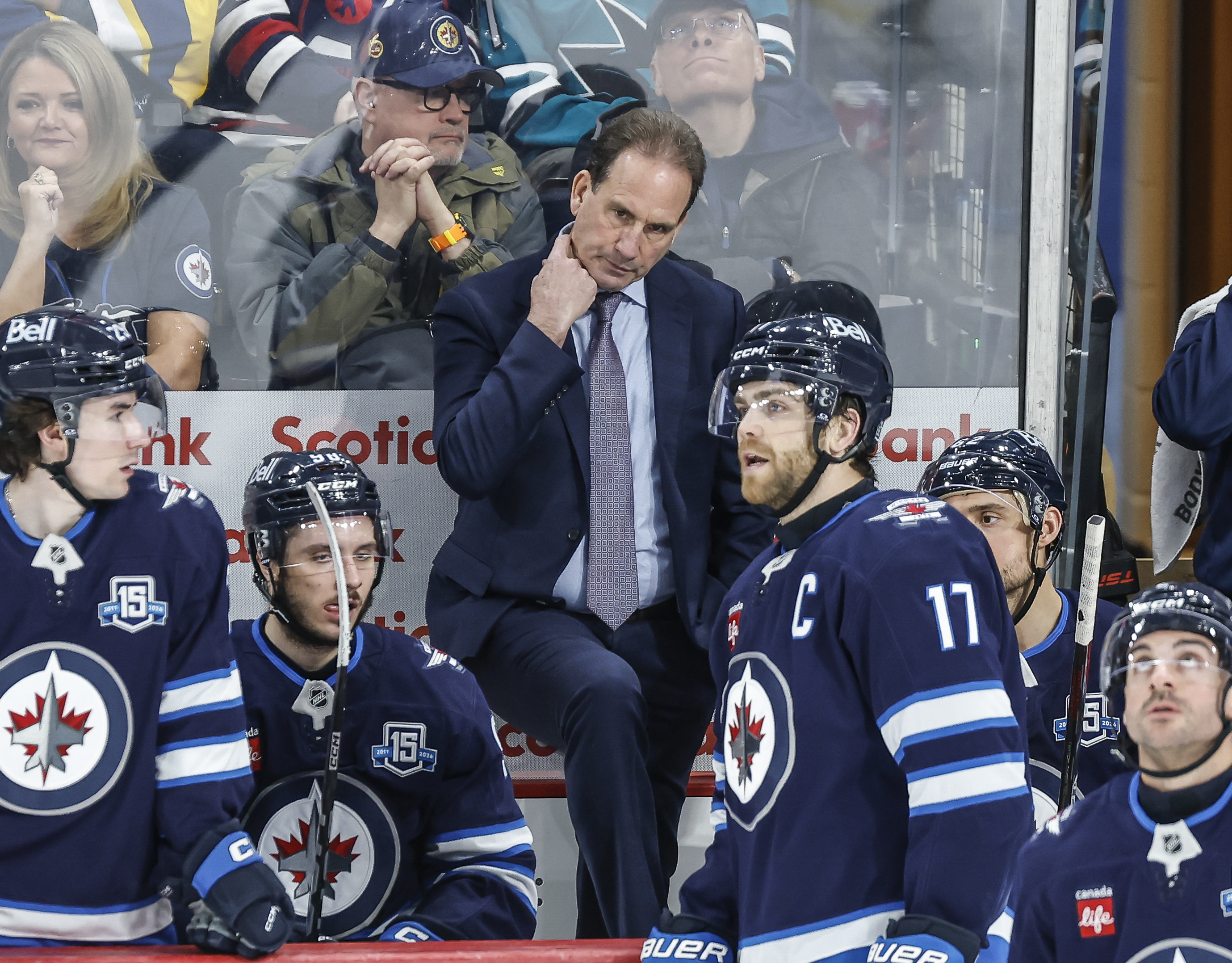
The Winnipeg Jets represent a case study in the diminishing returns of loyalty within a closed system. While continuity is often marketed as a competitive advantage in the National Hockey League, for the Jets, it has transitioned into a structural bottleneck. The organization operates under a "Loyalty-First" heuristic that prioritizes internal stability over external optimization. This strategy fails because it ignores the high opportunity cost of retaining aging assets and coaching philosophies that have already peaked. To break the cycle of early-exit postseason performances, the Jets must shift from a sentimental management model to a performance-integrated framework that treats every roster spot and staff position as a variable in a maximum-output equation.
The Sunk Cost Fallacy of Core Retention
The primary inhibitor to the Jets' evolution is the emotional and financial over-investment in a specific "core" of players whose statistical impact is declining while their cap hits remain static or rise. This is a classic application of the sunk cost fallacy: the belief that because the organization has invested a decade of development and high-value draft picks into a player, they must continue to invest until a championship is achieved.
In a hard-cap environment, the value of a player is not their absolute talent, but their surplus value—the gap between their on-ice contribution and their salary cap hit ($Contribution - $CapHit = Surplus$). The Jets currently carry several veteran contracts where the surplus value is either zero or negative.
The Three Pillars of Roster Atrophy
- Instructional Drift: When a core remains together for too long under the same organizational ethos, the tactical response to adversity becomes predictable. Opponents develop "solved" scouting reports that remain effective year-over-year.
- Asset Depreciation: By refusing to trade "loyal" players at their peak market value, the Jets lose the ability to replenish the talent pipeline with high-leverage entry-level contracts.
- Cultural Ennui: A locked roster creates a glass ceiling for younger prospects. When performance is not the sole arbiter of ice time, the competitive drive within the bottom six forwards and bottom pair defensemen is suppressed.
The Tactical Rigidity of Systemic Loyalty
The Winnipeg Jets’ coaching history reflects a preference for "known quantities" over tactical innovators. This creates a feedback loop where players are drafted and developed to fit a specific, rigid system, rather than the system evolving to exploit the unique talents of the modern, high-speed NHL player.
The cost of this rigidity is most visible in the transition game. Data indicates that championship-caliber teams excel at controlled zone entries and high-danger passing sequences. The Jets’ loyalty to a conservative, dump-and-chase defensive shell limits their offensive ceiling. This is not a lack of talent; it is a failure of the tactical framework to allow for variance and creativity.
The Jets' power play serves as a quantitative proof of this stagnation. Despite possessing elite finishing talent, the team often ranks in the middle of the league in expected goals per 60 minutes ($xG/60$) on the man advantage. The refusal to deviate from a 1-3-1 setup that has been scouted to death by penalty-kill coaches across the league is a direct result of the "loyalty to the process" mindset.
Quantifying the Threshold of Diminishing Returns
Every NHL roster has a "Peak Performance Window." For the Jets, the window defined by the primes of their core players—specifically in the age 24-28 bracket—has largely closed. The organization is now entering the "Efficiency Decline" phase.
The Logic of the Trade-Off
To visualize the Jets' current predicament, consider the relationship between Experience and Explosiveness.
- Experience (The Jets’ current priority): High floor, low ceiling. Results in consistent regular-season wins but vulnerability against high-tempo, innovative playoff opponents.
- Explosiveness (The required pivot): High ceiling, higher variance. Requires a willingness to integrate younger, faster, and less-tested assets who can provide the "burst" necessary to overcome elite defensive structures.
The failure to pivot toward explosiveness is a failure of risk management. Management views the risk of "missing the playoffs" during a re-tool as greater than the risk of "repeated mediocrity." This is a risk-averse strategy that satisfies the bottom line but fails the competitive objective of a professional sports franchise.
The Geography of the Small Market Excuse
A recurring narrative in the Jets' decision-making is the "Small Market Constraint." The logic suggests that because Winnipeg is a difficult destination for high-profile free agents, the team must over-pay and over-retain their own players to remain relevant. This is a false dichotomy.
While it is true that the Jets struggle to sign top-tier unrestricted free agents (UFAs), the solution is not to cling to existing assets indefinitely. Instead, the solution is to become a "Laboratory of Innovation." Small-market teams in other professional sports (such as the Tampa Bay Rays in MLB) succeed not by being loyal, but by being colder and more analytical than their large-market peers.
- The Rays Model: Sell high on popular veterans to acquire multiple high-upside assets.
- The Jets Model: Hold veterans until their trade value is negligible, then let them walk for nothing or over-pay for their declining years.
The "Small Market" reality should dictate a higher churn rate, not a lower one. The goal is to maximize the number of high-value draft picks and prospects entering the system to ensure a constant supply of cheap, elite labor.
Structural Bottlenecks in Player Development
The Jets’ loyalty extends to their development pathways, which often prioritize "safety" over "ceiling." This results in a roster filled with high-floor, low-ceiling role players who lack the game-breaking ability to win individual matchups in a seven-game series.
The "Draft and Develop" mantra is only effective if the "Develop" stage involves meaningful adaptation. The Jets' prospect pool often stagnates in the American Hockey League (AHL) because the path to the NHL is blocked by veterans on "loyalty" contracts. This creates a secondary cost: the devaluation of prospects. A prospect who is NHL-ready but buried on the depth chart loses trade value and development momentum.
The Mechanism of Prospect Stagnation
- Restricted Opportunity: Young players receive "safe" minutes (low leverage, defensive starts) which prevents them from developing offensive instincts at the NHL level.
- Incongruent Evaluation: Players are judged on their ability to minimize mistakes rather than their ability to create high-danger chances.
- Contractual Entrenchment: Veteran players with No-Move Clauses (NMCs) or high salaries are given preferential treatment in the lineup regardless of recent performance metrics.
The Requirement for a Rational Pivot
The path forward for the Winnipeg Jets requires a cold, data-driven audit of the entire organization. This is not a "rebuild" in the traditional sense of bottoming out for draft picks; it is a "re-alignment" of the organizational logic model.
1. The Asset Liquidity Initiative
The Jets must identify every player over the age of 29 whose contract exceeds their projected $xG$ contribution over the next three seasons. These players must be transitioned into trade assets while they still possess "reputation value" to other NHL GMs. The goal is to convert aging certainty into youthful volatility.
2. Tactical Decentralization
The coaching staff must move away from a top-down, rigid system and toward a decentralized model that allows for individual player variance. This involves hiring "Specialist Coaches" (e.g., transition specialists, power play architects) who are empowered to override the head coach’s traditionalist instincts.
3. The End of the "Winnipeg Discount"
Management must stop using the city’s geography as an excuse for conservative roster building. The "Winnipeg Discount" is not a lack of free agents; it is the mental tax the organization pays by being afraid to let go of players they believe they cannot replace. Every player is replaceable if the scouting and development systems are functioning at an elite level.
The Probability of Success vs. The Comfort of Consistency
The Jets are currently optimized for a 15% to 20% chance of making a deep playoff run. By maintaining the status quo, they ensure they remain a "competitive" team that sells tickets and stays relevant in the local market. However, if the objective is to increase that probability to 50% or higher, the organization must accept a period of higher variance.
Loyalty is a virtue in personal relationships, but in a multi-billion dollar competitive industry, it is a variable that must be managed. When loyalty interferes with the objective evaluation of talent and tactics, it becomes a liability.
The Jets must choose between the comfort of a familiar, stagnant core and the uncertainty of a modernized, high-velocity organization. The former leads to more first-round exits and the eventual erosion of the fan base's patience. The latter offers the only realistic path to a championship.
The final strategic move is not a single trade or a single coaching change. It is a fundamental shift in the organizational "Operating System" from a Stability-Based Model to a Performance-Based Model. This requires the courage to alienate "loyal" veterans and the discipline to prioritize math over memory. If the Jets do not initiate this change internally, the market and the aging curve will eventually force it upon them, likely at a much higher cost and from a much weaker position. The time for sentimentality has passed; the era of ruthless optimization must begin.