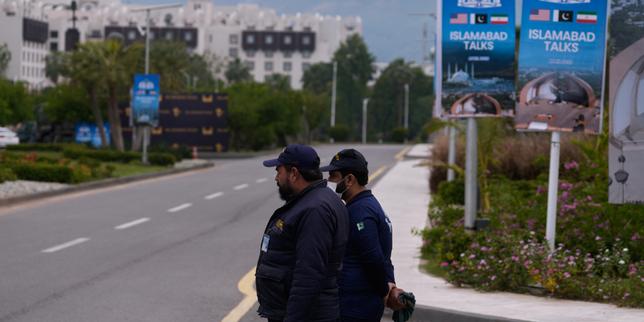
The arrival of a high-level Iranian delegation in Pakistan for mediated peace talks with United States intermediaries signifies a shift from kinetic confrontation to a structured diplomatic containment model. This shift is not a product of sudden altruism but a response to a specific cost-benefit threshold where the risk of regional contagion outweighs the utility of proxy friction. The current negotiations represent a three-tier stabilization framework designed to decouple the specific localized border tensions between Tehran and Islamabad from the broader, more volatile theater of the Middle East conflict.
The Strategic Triad of De-escalation
Regional stability in this context rests on three distinct pillars of interest that have forced these parties to the table. Each pillar functions as a pressure valve for the domestic and international constraints currently binding the leadership in both Tehran and Islamabad.
1. The Domestic Security Imperative
Both Iran and Pakistan face internal insurgencies that utilize the porous Sistan-Baluchestan border as a tactical sanctuary. The recent cycle of tit-for-tat missile strikes demonstrated a critical failure in intelligence and deterrence.
- For Iran: Stabilizing the eastern flank allows for a consolidation of resources toward the "Axis of Resistance" in the Levant and the Red Sea. Managing two active fronts—one with Israel/USA and one with a nuclear-armed neighbor—creates an unsustainable drain on the Islamic Revolutionary Guard Corps (IRGC) kinetic capacity.
- For Pakistan: The military establishment cannot afford a hot border with Iran while simultaneously managing an economic crisis and heightening tensions with the Tehrik-i-Taliban Pakistan (TTP) on the Afghan frontier.
2. The Economic Corridor Constraint
The involvement of external powers like China acts as a stabilizing force. The China-Pakistan Economic Corridor (CPEC) requires a predictable security environment to attract the capital necessary for infrastructure completion. A conflict between Iran and Pakistan threatens the maritime security of the Port of Gwadar and the stability of the energy pipelines that are vital for Pakistan’s industrial recovery.
3. The US Mediatory Calculus
The presence of US-linked negotiations on Pakistani soil reveals a pragmatic pivot. The Biden administration seeks to prevent the expansion of the Gaza-Israel conflict into a wider regional war. By using Pakistan as a conduit, the US can communicate "red lines" to Tehran without the political theater of direct bilateral talks, which remain domestically toxic for both Washington and Tehran.
Analyzing the Mediation Mechanism
The mechanics of these negotiations involve a specific "Backchannel Arbitration Model." Unlike traditional summits, these talks function through a series of technical working groups focused on intelligence sharing and border management protocols.
The Buffer Zone Protocol
The primary objective of the delegation is the establishment of a formalized security architecture. This involves:
- Joint Intelligence Cells: Moving from reactive strikes to preemptive information sharing regarding militant movements (specifically Jaish al-Adl and the Baloch Liberation Army).
- Demarcated Kinetic Rules: Establishing a clear "escalation ladder" to ensure that accidental border skirmishes do not trigger missile-based retaliations.
The Role of Third-Party Verification
The inherent lack of trust between the IRGC and the Pakistani Inter-Services Intelligence (ISI) means that any agreement requires a verification mechanism. This is where the US presence—even if indirect or through intermediaries—becomes functional. The US provides the technical surveillance and financial leverage (via IMF or FATF pressures on Pakistan) to ensure compliance.
The Structural Bottlenecks of Peace
Despite the arrival of the delegation, several structural constraints limit the depth of any potential "peace."
The Proxy Paradox
Iran’s regional strategy is predicated on the use of non-state actors to project power while maintaining plausible deniability. Pakistan’s historical use of similar assets creates a situation where both states are effectively negotiating against their own long-term strategic habits. If Iran curtails its support for specific groups to appease Pakistan, it risks losing influence within the broader regional militant ecosystem.
The Nuclear Variable
Pakistan’s status as a nuclear power changes the math of Iranian provocation. Unlike the asymmetric warfare Iran conducts against Israel or Saudi Arabia, a conflict with Pakistan carries the theoretical risk of nuclear escalation. This reality forces a ceiling on how far Iran can push its "forward defense" policy in the east.
Revenue and Sanctions
The economic reality dictates that Iran needs markets. Reopening trade with Pakistan is a method of bypassing Western sanctions. However, Pakistan’s reliance on US-led financial institutions creates a friction point. Islamabad must balance its need for Iranian energy and trade with the threat of secondary US sanctions.
Quantifying the Probability of Success
If success is defined as a total cessation of hostilities and a return to the status quo ante, the probability remains moderate. A data-driven assessment suggests the following outcomes:
- Tactical De-escalation (65% Probability): Both nations agree to a temporary halt in cross-border strikes and establish a hotline. This serves immediate domestic needs but leaves the root causes of the insurgency unaddressed.
- Fragmented Stalemate (25% Probability): Negotiations stall due to IRGC hardliners or internal Pakistani political shifts. Low-level skirmishes continue, but are contained to the border region.
- Comprehensive Security Pact (10% Probability): A full normalization of relations including joint military patrols and energy trade. This is unlikely given the current US-Iran friction and the volatility of the Middle East.
Strategic Realignment and the New Security Map
The arrival of the Iranian delegation in Pakistan should be viewed as a recalibration of the regional security map. The "Western Front" of the Middle East conflict is now effectively tethered to the "Eastern Front" of South Asian geopolitics.
The second-order effect of these negotiations will be the isolation of militant groups that previously benefited from the lack of coordination between Tehran and Islamabad. By synchronizing their border responses, both states are effectively closing the "sovereignty gap" that insurgents have exploited for decades.
This creates a new bottleneck for regional terror groups: they can no longer play one state against the other. However, this synchronization also increases the risk that any future failure in the diplomatic process will result in a more coordinated and violent breakdown of regional order.
The final strategic move for the international community is to monitor the specific nature of the border security agreements. If the agreements include technical infrastructure—such as integrated sensor arrays or shared radar data—the de-escalation will be durable. If the agreements remain limited to rhetorical commitments of "brotherly cooperation," the current peace is merely a tactical pause while both sides reload. The success of the Iranian delegation hinges entirely on their willingness to trade proxy influence for border integrity, a trade-off that Tehran has historically been reluctant to make.