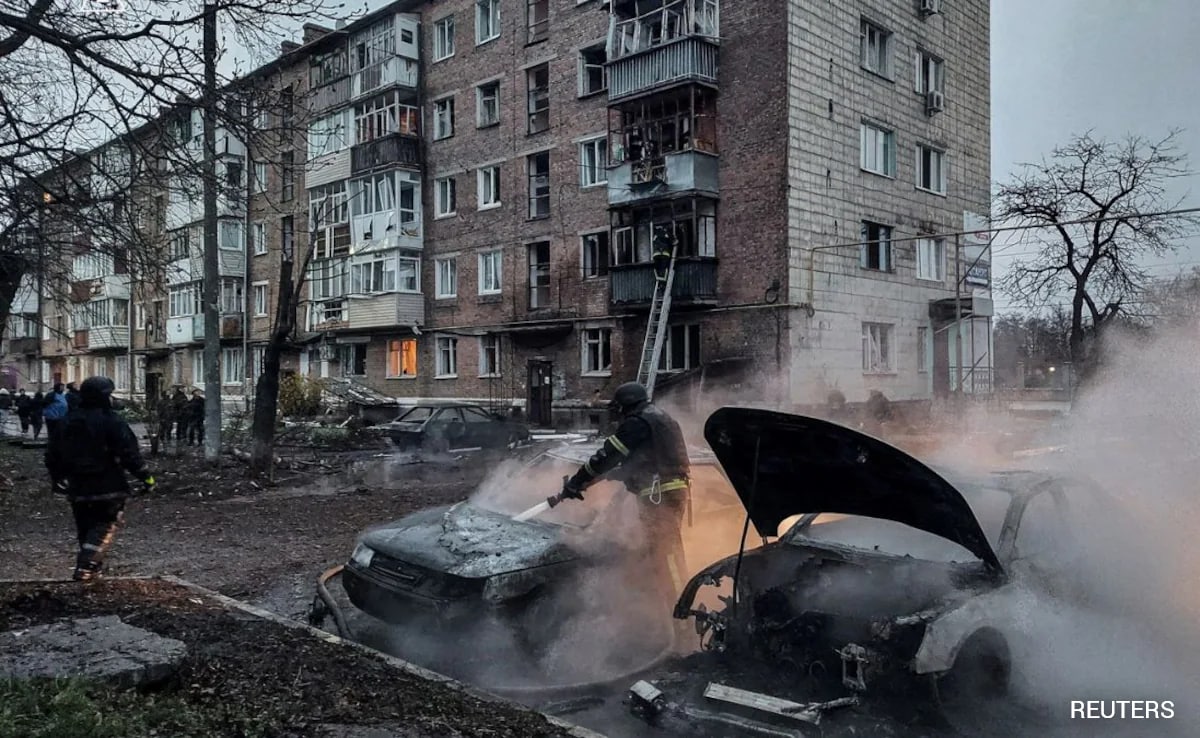
The notion of an Easter truce in the conflict between Russia and Ukraine has once again proven to be a diplomatic ghost. While various international bodies and religious leaders spent weeks calling for a temporary cessation of hostilities to mark the Orthodox holiday, the reality on the front lines remained a grim display of artillery exchanges and tactical maneuvering. This failure is not a matter of scheduling or a lack of piety. It is the result of a fundamental shift in how both Moscow and Kyiv perceive the utility of time. In a war of attrition, a "truce" is not a breather; it is a logistical window that neither side can afford to grant the other.
The collapse of these negotiations reveals a brutal truth about the current stage of the war. We are no longer in a phase where symbolic gestures hold any political currency. For Ukraine, any pause allows Russian forces to solidify defensive lines and dig deeper into occupied territories. For Russia, a halt in momentum risks domestic perceptions of weakness and gives Kyiv time to integrate fresh Western hardware. The failure of the Easter truce is the clearest indicator yet that both combatants have fully committed to a long-term struggle where the calendar is just another weapon.
The Logistics of a Broken Promise
To understand why the guns never fell silent, one must look at the math of modern warfare rather than the rhetoric of peace. Artillery cycles do not stop for holidays. In the weeks leading up to Easter, both internal intelligence reports and open-source satellite imagery showed a marked increase in ammunition repositioning. When one side observes the other stockpiling shells, the incentive to strike first outweighs any religious or humanitarian consideration.
Military commanders on the ground view a 48-hour pause as a high-risk liability. If a unit stops its reconnaissance drones or pulls back its mobile battery units for a holiday, they become sitting ducks the moment the clock strikes midnight on the following day. This is the "Truce Trap." In previous conflicts, like the Christmas Truce of 1914, the technological lag allowed for localized, spontaneous peace. Today, with 24-hour thermal surveillance and precision strike capabilities, the element of surprise is too valuable to trade for a handshake in the mud.
The Religious Schism as a Front Line
The role of the Church in this conflict has shifted from a potential peacemaker to a primary driver of division. The Orthodox world is currently fractured between the Moscow Patriarchate and the independent Orthodox Church of Ukraine. This isn't just a theological debate; it is a matter of national security.
When the Kremlin suggests a truce based on shared religious values, Kyiv sees a Trojan horse. The Ukrainian government has spent the last year cracking down on elements of the church they believe are acting as conduits for Russian intelligence. Consequently, a religious holiday is no longer a neutral ground. It is a contested space where every prayer and every liturgy is scrutinized for political loyalty. You cannot have a religious truce when the faith itself has been drafted into the infantry.
The Myth of the Humanitarian Corridor
During these failed negotiations, much was made of the need for humanitarian windows to evacuate civilians. However, the track record of these corridors in the Russo-Ukrainian war is abysmal. History shows that these "safe zones" often become bottlenecked targets or tools for forced displacement.
By framing a truce around humanitarian needs, negotiators often inadvertently create a checklist for military targets. If a specific road is designated for civilian exit, it becomes the most heavily surveilled piece of asphalt in the region. The cynical reality is that both sides use the collapse of truce talks to win the "blame game" in the international press. Russia claims Ukraine is "godless" for refusing a holy pause, while Ukraine points to ongoing shelling as proof of Russian duplicity. The civilians, meanwhile, remain trapped in the middle of a sophisticated PR machine.
Hardware vs Heart
There is a pervasive belief in some Western circles that the sheer exhaustion of troops will eventually force a pause. This overlooks the industrialization of the conflict. This war is increasingly defined by machines—FPV drones, automated sensor arrays, and remote-triggered mines.
Machines do not need to celebrate Easter.
The integration of AI-driven targeting and 24-hour drone loops has effectively removed the "human" element from the decision to keep firing. Even if a platoon leader wanted to honor a holiday, the high-level operational command is focused on "density of fire" and "suppression cycles." If the guns stop, the enemy moves. If the enemy moves, your position is lost. This feedback loop creates a permanent state of engagement that is nearly impossible to break without a formal, monitored treaty—something neither side is currently willing to sign.
The Strategy of Exhaustion
Russia’s current doctrine is built on the premise that it can outlast the West’s attention span. A truce, in Putin’s view, only serves a purpose if it contributes to the long-term degradation of Ukrainian resolve. If a ceasefire doesn't lead to a frozen conflict on Russian terms, it has no value to the Kremlin.
On the other side, the Zelenskyy administration is acutely aware of "ceasefire fatigue." They know that every time a truce is discussed, it reinforces the narrative that the war is a stalemate. For Ukraine, a stalemate is a slow-motion defeat. They must maintain a high operational tempo to prove to their donors in Washington and Brussels that victory is still possible. Peace, even for 24 hours, risks cooling the political engine that keeps the weapons flowing.
The Ghost of the Minsk Agreements
The shadow of the failed Minsk I and II agreements looms over every modern attempt at a truce. Ukrainian officials frequently cite these previous deals as evidence that Russia uses "quiet time" to reorganize and re-arm. They feel they were burned by diplomacy in 2014 and 2015, and they have no intention of repeating that mistake.
This historical baggage has created a culture of deep-seated skepticism. In the corridors of power in Kyiv, "truce" has become a dirty word. It is seen as a synonym for "concession." Until the fundamental territorial disputes are resolved, or one side suffers a total systemic collapse, any talk of a temporary halt is merely background noise to the thud of 155mm rounds.
The Internal Politics of No Surrender
Both nations are currently locked into internal political cycles that punish moderation. In Russia, the nationalist "Z-bloggers" and hardline military commentators view any talk of a truce as a betrayal of the soldiers in the trenches. They demand total victory and see humanitarian pauses as a sign of liberal rot within the military high command.
In Ukraine, the public mood is equally hardened. After the atrocities documented in places like Bucha and Irpin, the appetite for any form of cooperation with Moscow—even for a holiday—is non-existent. A leader who suggests a truce without a corresponding Russian withdrawal risks a massive domestic backlash. This "political gravity" makes it safer for both leaders to keep the war moving than to risk the uncertainty of a pause.
The Role of Global Observers
The international community, particularly the UN and the Vatican, continues to play a role that is more performative than practical. Their calls for an Easter truce are directed more at their own constituencies than at the commanders in the Donbas. By demanding peace when the conditions for it do not exist, these institutions risk becoming irrelevant.
They fail to account for the "economy of the front." In a high-intensity conflict, the status quo is movement. Stopping that movement requires a massive expenditure of political capital that no one is willing to spend for a two-day reprieve. The international community needs to stop asking for "pauses" and start addressing the structural reasons why the war is being fought, though that is a far more difficult and dangerous task.
The Weaponization of the Calendar
As we move past the Easter period, the focus will shift to the next symbolic date. The calendar has been weaponized, with each holiday serving as a deadline for a new offensive or a fresh round of missile strikes. This creates a psychological toll on the civilian population that is often overlooked. Instead of holidays being a source of hope, they have become periods of heightened anxiety and "red alerts."
The failure of the Easter truce is not a breakdown of the system; it is the system working exactly as intended. It is a system designed to maximize pressure and minimize the enemy's ability to recover. In this environment, the only thing that matters is the "kill chain"—the process of identifying, targeting, and destroying a threat. That process does not have a "pause" button.
Beyond the Symbolic
If we are to find a way out of this cycle, it will not be through religious appeals or symbolic dates. It will be through a shift in the strategic calculus that makes the cost of fighting higher than the cost of sitting down. Currently, that balance has not been reached. Both sides still believe they can improve their position through force.
The "Easter Truce" was never about peace. It was a litmus test for the exhaustion of the combatants. The fact that it failed so completely tells us everything we need to know about the year ahead. The war is not winding down; it is hardening. The trenches are getting deeper, the drones are getting smarter, and the room for diplomacy is shrinking to the size of a postage stamp.
We are witnessing the birth of a permanent war footing in Eastern Europe. The failure to stop for a single day of prayer is a signal to the world that the time for symbolic gestures has passed. The only thing that will stop the firing now is a total shift in the geopolitical landscape or the absolute depletion of one side's ability to resist. Until then, the holidays will continue to be marked by the sound of sirens and the flash of impact.
Do not look for the next truce on the calendar; look for it in the casualty reports and the ammunition logs.