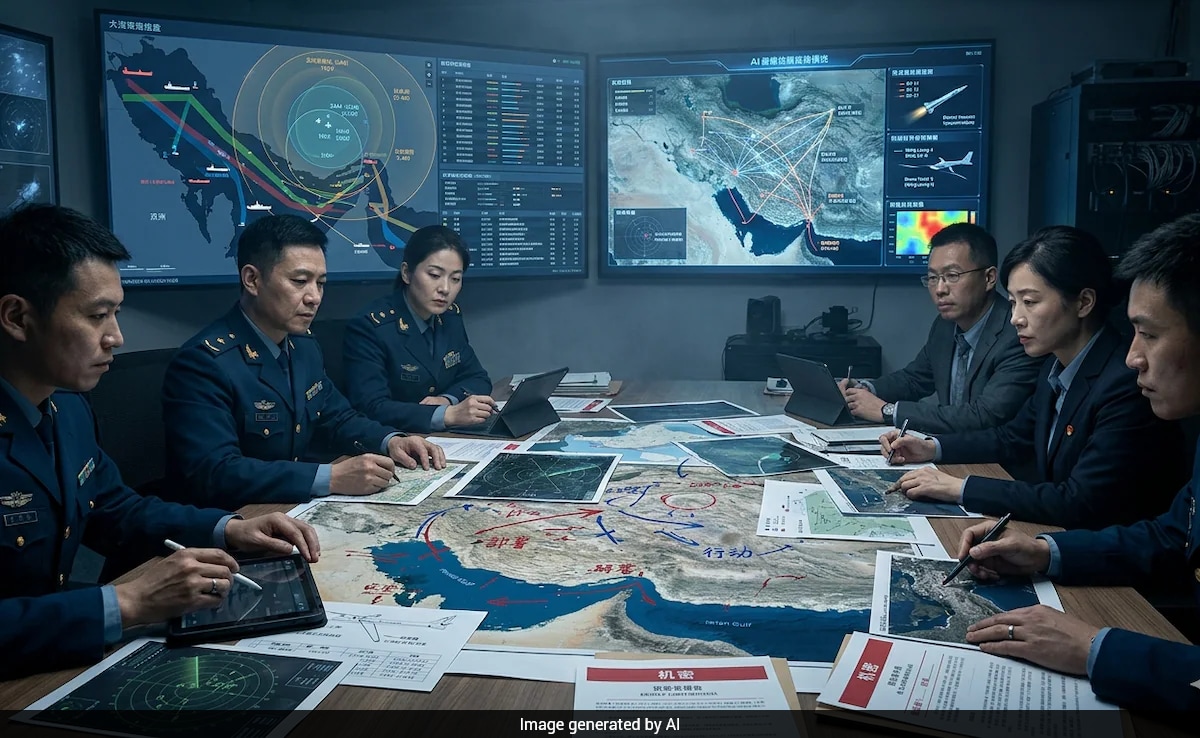
Beijing isn't just watching the explosions in the Middle East. It’s grading the homework. Every time a U.S.-made interceptor hits a drone over the Persian Gulf or a specialized missile finds its mark in an Iranian-backed facility, Chinese military planners are taking notes. They’re looking for the gaps. They want to see how American logistics hold up when the pressure stays on for months, not days. If you think the tension between Iran and the West is just a regional spat, you’re missing the bigger picture. This is a live-fire laboratory for the People’s Liberation Army (PLA).
The reality is that China hasn't fought a major war since 1979. They have plenty of shiny hardware, but they lack "combat sweat." To fix that, they’re obsessive about studying everyone else’s fights. The current shadow war involving Iran, its proxies, and the United States provides a gold mine of data on how modern American power actually functions when it's forced to multitask.
Washington’s Achilles Heel In A Long War
One thing Chinese analysts have spotted is that the U.S. is incredible at the "first punch" but struggles with the "long haul." We saw this with the massive expenditure of high-end munitions to take down cheap, mass-produced drones. When Iran or its partners launch a swarm of $20,000 suicide drones and the U.S. responds with $2 million missiles, the math works against the Pentagon. Beijing sees this. They know that in a potential conflict over the Taiwan Strait, they can produce drones at a scale and price point that could technically bankrupt an opponent's defense budget.
It’s about the industrial base. Chinese military journals often highlight that American manufacturing isn't what it used to be. They see the struggle to replenish stockpiles of 155mm shells and air defense interceptors. To the PLA, this suggests that if they can make a conflict last long enough, they might just outproduce the West. They’re moving away from the idea of a quick "decapitation" strike and thinking more about a war of attrition where the factory floor is as important as the cockpit.
The Myth Of Total Air Superiority
For decades, the world assumed the U.S. Air Force owned the sky. If you were on the ground, you were in trouble. The Iran conflict has cracked that certainty. Drones and long-range ballistic missiles have turned the sky into a contested mess, even without a rival nation-state flying fighter jets.
China is paying close attention to how Iran uses "asymmetric" tools to keep the U.S. Navy at a distance. They’re studying the tactical success of anti-ship ballistic missiles. If a relatively isolated power like Iran can threaten shipping lanes and naval assets, China—with its massive DF-21D and DF-26 "carrier killer" missiles—believes it can create a total "no-go" zone in the First Island Chain. They aren't just looking at the missiles themselves. They’re looking at the sensors. They want to know how the U.S. detects these launches and how much warning time is actually available.
Digital Warfare And The Invisible Front
Don't ignore the bytes. Every kinetic strike in the Middle East is preceded and followed by a flurry of electronic warfare. China is watching how the U.S. protects its satellite links and GPS signals. Iran has tried—and occasionally succeeded—in jamming or spoofing signals to bring down smaller drones.
The PLA has a whole branch dedicated to this: the Strategic Support Force. They believe the next war will be won or lost in the "information domain" before a single shot is fired. They're observing how U.S. command and control structures react when their communications are disrupted. Can the American military still fight if the "all-seeing eye" of the satellite network goes dark? The Iran conflict suggests that while the U.S. is still the leader, it’s vulnerable to "electronic noise" in ways it wasn't twenty years ago.
Intelligence Gaps And The Human Element
One surprising takeaway for Beijing is the inconsistency of U.S. intelligence. Despite the massive technological advantage, the U.S. is often surprised by the timing or the scale of Iranian-backed moves. This tells China that American "over-the-horizon" capabilities aren't a crystal ball.
There’s also the political dimension. China observes how domestic American politics affects military deployments. They see the hesitation. They see the debates in Congress. They realize that the U.S. military doesn't operate in a vacuum—it operates on a leash held by voters and politicians who might not have the stomach for another "forever war." Beijing's leadership doesn't have that particular constraint. They can take a fifty-year view while Washington often struggles to look past the next election cycle.
Real World Application For The Pacific
So, what does this mean for the next few years? China is already tweaking its training exercises based on these observations. They’re focusing on:
- Integrated Air Defense: Building systems that can handle a mix of high-speed missiles and low-speed drones simultaneously.
- Logistics Resilience: Moving away from centralized hubs that can be easily targeted by long-range strikes.
- Mass Production: Doubling down on the ability to churn out "good enough" tech in massive quantities to overwhelm sophisticated defenses.
They’re also looking at the concept of "integrated deterrence." If they can show the U.S. that the cost of intervention is too high—not just in lives, but in the sheer depletion of the American arsenal—they might win without ever firing a shot.
The Strategy Shift You Should Watch
The big move isn't more aircraft carriers. It’s more magazines. China is obsessed with "magazine depth"—having more shots than the other guy has shields. They’ve seen the U.S. struggle to keep up with the demand for interceptors in the Middle East and they're betting they can create a similar, but much larger, problem in the Pacific.
You should keep an eye on Chinese defense spending specifically related to "low-cost attrition" weapons. If you see a massive spike in drone manufacturing and medium-range ballistic missiles, you know they’ve learned the lesson well. They aren't trying to build a better version of the U.S. military. They're trying to build a military that makes the U.S. model obsolete through sheer volume and persistent pressure.
Stop looking at the Iran conflict as a side show. For the people planning the future of the Pacific, it’s the main event’s dress rehearsal. The U.S. needs to stop showing its hand so clearly, or at the very least, start changing the game so the lessons Beijing is learning today don't work tomorrow. That means diversifying the supply chain, investing in directed-energy weapons like lasers that don't "run out" of ammo, and admitting that the era of uncontested dominance is officially over.