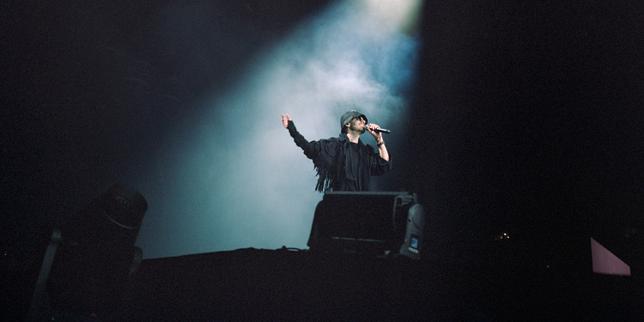
The air in Budapest’s Heroes' Square recently carried a vibration that hadn't been felt in nearly two decades. It wasn’t just the bass from a seven-hour marathon of rock and pop, but the sound of a political monopoly beginning to crack. When Péter Magyar, a former insider turned whistleblower, summoned tens of thousands to a musical protest, he wasn't just organizing a gig. He was stress-testing the endurance of Viktor Orban’s "Illiberal Democracy." For the first time since the Fidesz party consolidated its grip on the Hungarian state, the opposition has moved past the stage of fragmented shouting and into a unified, rhythmic defiance that leverages the one thing the regime cannot easily censor: the collective cultural identity of a frustrated middle class.
The spectacle was more than a performance. It represented a strategic shift in how the Hungarian resistance operates, moving away from dry policy debates and toward an emotional, high-energy mobilization that mimics the very populist tactics Orban used to seize power. By merging a massive free concert with a political rally, Magyar has tapped into a deep-seated fatigue among the youth and the urban professionals who feel alienated by the government’s tightening control over media, education, and the judiciary.
The Insider Who Broke the Code
Péter Magyar is an unlikely revolutionary. For years, he occupied the upper echelons of the Fidesz ecosystem, benefitting from the very patronage networks he now decries. His defection followed a high-profile clemency scandal involving a cover-up in a pedophilia case, an event that deeply wounded the "family values" image Orban has meticulously cultivated. Magyar’s value lies not in a radical new ideology, but in his intimate knowledge of the regime's plumbing. He knows where the pipes are leaky.
Unlike previous opposition figures who were easily painted as "Brussels puppets" or "Soros agents" by the state-controlled media, Magyar is a product of the system. He speaks the language of the Hungarian right. He uses their symbols. When he stands on a stage in front of a sea of national flags, the government's usual smear tactics lose their edge. You cannot easily brand a man a traitor when he looks and sounds exactly like the people you claim to represent.
Music as a Tactical Weapon
The decision to host a seven-hour concert was a calculated move to bypass the "outrage fatigue" that has plagued Hungarian activism. Traditional protests in Budapest often follow a predictable, somber script: a few speeches, a march to the Parliament, and a quiet dispersal. They are easy to ignore. A marathon concert, however, creates a physical and temporal space that the state cannot simply sweep under the rug.
Music provides a layer of protection. When thousands sing along to anthems of freedom, it becomes a communal experience that transcends the individual. It builds "social capital" in a way that a political leaflet never could. The performers who took the stage—many of whom have faced unofficial blacklisting for their views—lent their cultural weight to the movement, signaling to the public that the cost of silence is now higher than the cost of dissent.
The Economic Undercurrents of Dissent
While the headlines focus on the "end of the regime," the reality is rooted in the checkbook. Hungary has weathered some of the highest inflation rates in the European Union over the past two years. The populist bargain—social stability and cheap energy in exchange for diminished democratic freedoms—is failing.
- Real wages have stagnated while the cost of basic groceries has surged.
- EU funds remain largely frozen due to rule-of-law disputes, starving the government of the capital it usually uses to grease the wheels of its patronage machine.
- The healthcare and education sectors are in a state of visible decay, with teachers and nurses frequently leading the charge in street demonstrations.
Orban’s power has always rested on his ability to deliver tangible, if uneven, prosperity. Without the ability to spend his way out of trouble, the cracks in the facade become impossible to ignore. The Budapest concert was the soundtrack to this economic disillusionment.
Media Hegemony and the Digital Counter-Strike
One cannot analyze Hungarian politics without addressing the KESMA (Central European Press and Media Foundation) behemoth. This entity controls hundreds of media outlets, ensuring a singular narrative reaches the rural heartlands. In this environment, a concert in the capital is a vital disruption. It creates "un-ignorable" content for social media, which remains the only unregulated frontier in the country.
The regime's response has been a massive surge in ad spending on platforms like Facebook and YouTube, attempting to drown out Magyar’s message with character assassinations. Yet, there is a law of diminishing returns at play. The more the state screams that a popular movement is a "foreign plot," the more it appears out of touch with the reality on the ground. The sheer volume of the Budapest concert was a physical rebuttal to the digital wall the government has built around the Hungarian mind.
The Geometry of the New Opposition
The TISZA party (Respect and Freedom), which Magyar has adopted as his vehicle, is currently polling at levels that should terrify the Prime Minister's office. It is pulling voters not just from the traditional left-wing opposition, but crucially, from the disillusioned fringes of Fidesz itself. This is the "third way" that has eluded Hungarian politics for a decade.
The Rural-Urban Divide
The biggest hurdle remains the countryside. Budapest is a liberal island in a conservative sea. To truly precipitate the "end of the regime," Magyar must prove that he can take his seven-hour concerts and his message of "internal cleansing" to the smaller towns where the local mayor and the local priest are often the only sources of authority. The government’s grip on these areas is psychological as much as it is political.
The Brussels Factor
Orban has long used the European Union as a convenient punching bag. By framing every domestic failure as a result of "Brussels' sanctions" or "gender ideology," he has successfully deflected blame. Magyar’s challenge is to keep the focus on internal corruption. He is attempting to decouple Hungarian patriotism from Orbanism, arguing that one can be a proud Hungarian while demanding an end to the "feudal" system of oligarchic control.
A System Built to Survive
It would be a mistake to underestimate Viktor Orban. He is a master of the "long game" and has spent fourteen years rigging the electoral system to ensure that even a massive shift in popular vote does not necessarily lead to a loss of parliamentary power. Gerrymandering, control of the electoral commission, and the lack of independent oversight mean that a concert, no matter how loud, is only the beginning of a very long and dangerous road.
The regime is not going to collapse overnight. It will instead attempt to co-opt parts of the movement, intimidate its leaders, and wait for the momentum to fade. They are betting that the energy of a seven-hour concert cannot be sustained through an entire election cycle.
The Risk of the Single Point of Failure
The current movement is dangerously centered on the persona of Péter Magyar. This is its greatest strength and its most glaring vulnerability. If the government manages to successfully discredit him or if he makes a significant strategic error, there is no clear infrastructure to catch the falling pieces. The "regime" is a sprawling, institutionalized network; the opposition is currently a high-speed train with one engineer.
The Budapest concert proved that the desire for change is visceral and widespread. It showed that the fear which once kept people off the streets is evaporating. But a concert is an event; a revolution is a process. The real test will not be how many people sang in Heroes' Square, but how many of them are willing to do the boring, difficult work of building a political machine that can withstand the full weight of a state-sponsored counter-attack.
The music has stopped, but the ringing in the government’s ears is unlikely to fade anytime soon. The illusion of total control has been shattered, and in politics, once the aura of invincibility is gone, it never truly returns. The next move won't be made on a stage, but in the quiet, terrified offices of the district party leaders who finally realized that the crowd is no longer listening to them.