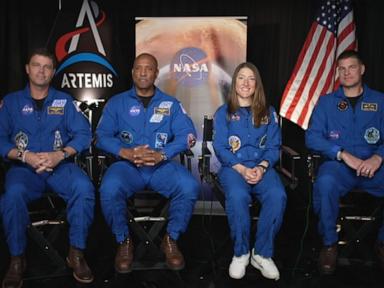
The four astronauts of Artemis II—Reid Wiseman, Victor Glover, Christina Koch, and Jeremy Hansen—are currently training for a violent encounter with Earth's atmosphere that will push the Orion spacecraft to its absolute physical limits. While much of the public conversation around the 2025 mission focuses on the majesty of the lunar flyby, the mission's success or failure hinges on a twenty-minute window of extreme deceleration. This is not a routine shuttle landing or a gentle SpaceX splashdown from low Earth orbit. This is a high-velocity ballistic reentry from deep space, a maneuver that hasn't been performed by human beings since Apollo 17 in 1972.
The heat shield of the Orion capsule will face temperatures of roughly 5,000 degrees Fahrenheit. That is half the temperature of the surface of the sun. As the spacecraft hits the atmosphere at approximately 25,000 miles per hour, the air in front of it won't just move; it will be compressed so violently that it turns into a glowing shroud of plasma. The crew isn't just "returning." They are survived a controlled meteor strike.
The Velocity Problem
To understand the intensity of the Artemis II reentry, one must first grasp the sheer scale of the energy involved. When an astronaut returns from the International Space Station (ISS), they are traveling at roughly 17,500 miles per hour. That is fast, but the physics of returning from the Moon are exponentially more punishing.
The Orion capsule will return at Mach 32. At these speeds, the friction of the atmosphere is secondary to the compression of the air. This "bow shock" creates a wall of heat that would vaporize any material known to man if not for the ablative properties of the heat shield. Orion uses a material called Avcoat, a reformulated version of the substance used during the Apollo era. It is designed to char and flake away, carrying the heat with it as it disintegrates.
The margin for error is razor-thin. If the entry angle is too steep, the G-loads will crush the crew, or the spacecraft will burn up. If the angle is too shallow, Orion will skip off the atmosphere like a stone across a pond, lost to the vacuum of space with no way to return. NASA’s flight controllers refer to this as the "entry corridor," a narrow window of safety only a few miles wide.
A Skip Entry for the Modern Era
One of the most significant differences between Artemis and its 20th-century predecessor is the "skip entry" maneuver. This is a complex flight path where Orion will actually dip into the atmosphere, "jump" back out briefly to shed heat and velocity, and then dive back in for the final descent.
For the crew, this means the physical sensation of gravity will be a roller coaster of extremes. They will go from the weightlessness of space to a crushing force of several Gs, back to a brief period of near-weightlessness, and then into the final high-G deceleration.
- Phase 1: Initial atmospheric interface. The first contact with the thin upper air.
- Phase 2: The skip. The capsule uses its lift-to-drag ratio to bounce upward, extending the range of the landing site.
- Phase 3: Final plunge. The most intense heat and pressure occurs here.
This maneuver allows NASA to target a landing site near San Diego regardless of where the spacecraft enters the atmosphere. It provides a level of precision the Apollo missions never had, but it places immense trust in the capsule's flight computers and the structural integrity of the heat shield.
The Human Cost of Deceleration
During the most intense portion of the descent, Wiseman, Glover, Koch, and Hansen will experience forces that make it difficult to breathe, let alone operate complex controls. The human body is remarkably resilient, but shifting from days of microgravity—where fluids shift to the head and muscles begin to atrophy—directly into a 6-G or 7-G environment is a physiological shock.
In recent interviews, the crew has described the training for this as "intense," a classic astronaut understatement. They spend hours in centrifuges, practicing the specific breathing techniques required to keep blood in the brain while their internal organs are pressed against their spines. They are training to remain conscious and capable of manual override in a situation where their vision may be blurring and their ribcages feel like they are under a hydraulic press.
There is also the "blackout" period. For several minutes, the plasma sheath surrounding the capsule will be so dense that radio waves cannot penetrate it. The crew will be entirely alone, cut off from Mission Control, hurtling through a firestorm.
Testing the Avcoat
The Artemis I mission, which was uncrewed, provided critical data on how the Orion heat shield handles these temperatures. While the mission was deemed a success, engineers noted some unexpected "charring" patterns on the Avcoat. Specifically, small pieces of the shield eroded differently than predicted in computer models.
NASA has spent the intervening years analyzing this "spallation"—the process of the shield material breaking off. For Artemis II, the stakes are different. There are lives inside the pressure vessel. The agency has conducted rigorous ground tests to ensure that the erosion seen on Artemis I was within safety margins.
The heat shield is essentially a giant 16.5-foot puzzle made of 180 blocks. Each block must be perfectly bonded. A single gap or a failed adhesive could allow a "plasma tongue" to lick the underlying titanium structure. If the structure is compromised, the mission ends in disaster. This isn't just engineering; it is a high-stakes bet against the laws of thermodynamics.
The Splashdown Architecture
Once the spacecraft survives the heat of reentry, the challenge shifts from thermodynamics to fluid dynamics. At roughly 25,000 feet, Orion will jettison its forward heat shield to expose the parachute bays.
The parachute sequence is a choreographed dance of nylon and Kevlar:
- Drogue Parachutes: Two small chutes deploy first to stabilize and slow the capsule.
- Pilot Parachutes: These pull out the three massive mains.
- Main Parachutes: These slow the 20,000-pound capsule to a survivable 20 miles per hour.
Even a "perfect" splashdown is a violent event. Orion is designed to hit the water at an angle to minimize the impact, but the crew will still experience a significant jolt. They then have to contend with the "ocean phase." Sitting in a small, bobbing capsule in the Pacific Ocean after days in space is a recipe for extreme seasickness. The recovery teams from the U.S. Navy must reach them quickly, not just for the sake of the mission's timeline, but because the crew will be at their most physically vulnerable in those first few minutes on the water.
The Reality of Deep Space Return
We have become used to the "easy" return of the commercial space era. Seeing a Falcon 9 booster land vertically on a drone ship or a Dragon capsule bobbing gently in the Gulf of Mexico has created a false sense of security regarding atmospheric entry.
Artemis II is a reminder that deep space is a different beast entirely. The energy levels are an order of magnitude higher. The speeds are greater. The heat is more intense. When the Artemis II crew hits the atmosphere, they aren't just coming home; they are proving that humanity can still handle the most violent physics the solar system has to offer.
The data gathered during those twenty minutes of fire will determine the future of the Artemis program. If the skip entry works as intended and the Avcoat shield holds, the path to the lunar surface with Artemis III is clear. If there are anomalies, the moon remains out of reach. Everything depends on the integrity of a few inches of charred resin and the endurance of four people trapped in a falling star.
Every bolt, every sensor, and every stitch in those parachutes must function perfectly under conditions that cannot be fully replicated on Earth. We are no longer in the era of low Earth orbit "taxis." We are back in the business of high-velocity exploration, where the atmosphere is both our greatest protector and our most dangerous adversary.