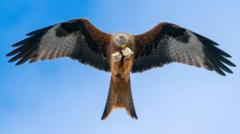
The seizure of processed meat products by Milvus milvus (the Red Kite) represents a sophisticated intersection of physiological evolution and human-centric environmental shifts. While casual observers frame the loss of a sausage roll as a comedic or frustrating anecdote, the event is actually a data point in a broader pattern of interspecific competition. This interaction is governed by the Theory of Optimal Foraging, where the bird calculates that the caloric reward of a high-fat human snack outweighs the energetic expenditure and risk of physical proximity to a larger primate.
The shift from carrion-based feeding to active kleptoparasitism in urban and peri-urban environments is not a behavioral quirk; it is a response to the artificial inflation of food density within human-managed spaces.
The Kinematics of the Strike
The Red Kite is anatomically optimized for the "grab-and-go" maneuver. Unlike the heavier Buteo buteo (Common Buzzard), which typically kills prey on the ground, the Red Kite possesses a high aspect ratio wing design and a deeply forked tail that functions as a high-precision rudder. This allows for extreme low-speed maneuverability, enabling the bird to adjust its flight path in milliseconds to intercept a moving target—such as a hand-held pastry.
The strike sequence follows a rigid mechanical progression:
- Scanning and Orbit: The bird utilizes thermal updrafts to maintain altitude while using high-resolution monocular vision to identify high-contrast objects (e.g., white paper bags or golden-brown pastry).
- The Stoop: A rapid descent phase where the bird minimizes its profile to reduce drag.
- The Extension Phase: The bird lowers its talons, which are equipped with specialized scales to increase grip friction.
- The Extraction: Unlike gulls, which often use their beaks for initial contact, kites use their feet. This keeps the bird's vital organs and sensory centers (the head) further away from the human threat during the moment of impact.
The force of the strike is often underestimated. While the bird weighs only $800$ to $1300$ grams, the momentum generated during a low-altitude swoop is sufficient to knock an object out of a human hand without the bird ever needing to land.
The Caloric Incentive Function
Why target a sausage roll instead of traditional prey like small mammals or invertebrates? The answer lies in the Energy Return on Investment (EROI).
A standard store-bought sausage roll contains a high concentration of lipids and carbohydrates. In biological terms, this is a "super-stimulus." A single 100g pastry can provide approximately 300-400 calories. For a raptor, this represents a significant portion of its daily field metabolic rate, achieved in a single three-second interaction.
- Natural Prey EROI: Hunting a field vole requires stalking, a high-energy pounce, and the risk of the prey escaping into cover. The caloric density is low due to the high proportion of bone and fur.
- Anthropogenic EROI: Stealing a sausage roll involves a predictable target (a human in a seated or standing position) and a massive energy payoff with zero processing time.
This creates a positive feedback loop. Once a kite successfully executes a theft, the behavior is reinforced through immediate caloric reward. Because these birds are long-lived (often exceeding 20 years in the wild), a single "learned" theft can lead to two decades of specialized kleptoparasitic behavior.
Mapping the Risk Zones
The probability of a kite-human conflict is a function of three variables: Population Density ($P$), Food Visibility ($V$), and Habitat Encroachment ($E$).
In areas where reintroduction programs have been highly successful, the local carrying capacity is often exceeded. This forces younger or less dominant birds into high-traffic human areas. The "sausage roll incident" typically occurs at the boundary of rural and suburban landscapes—picnic benches, garden parties, or outdoor markets.
The Three Pillars of Avian Opportunism
- Habituation: The reduction of the "fear response" due to repeated non-threatening exposure to humans. This is the primary driver of aggressive foraging.
- Visual Cue Association: Kites have begun to associate specific human behaviors—unwrapping crinkly plastic, sitting at a specific height, or holding hands near the chest—with the presence of high-fat food.
- Thermal Anchoring: Many urban centers create heat islands. Kites use the thermals generated by paved surfaces to loiter over human gatherings with minimal energy expenditure, waiting for the optimal moment to strike.
Mitigation and Behavioral Modification
Addressing this issue requires more than just "holding onto your food." It requires a shift in human environmental management. Traditional deterrents like scarecrows or reflective tape are ineffective against a raptor with the cognitive ability to recognize that these objects pose no physical threat.
The primary bottleneck in kite management is the lack of public understanding regarding the "feeding" hierarchy. Many people inadvertently train kites by offering small scraps, not realizing they are recalibrating the bird’s risk assessment. Once the bird views humans as a food source rather than a predator, the mechanical leap to active theft is inevitable.
Strategic interventions must focus on:
- Visual Obscuration: Reducing the line-of-sight between the sky and the food. Umbrellas, awnings, and even wide-brimmed hats disrupt the kite's "Scanning and Orbit" phase.
- Acoustic Disruption: Kites are sensitive to specific frequencies, though they habituate quickly. Random-interval noise is more effective than constant deterrents.
- Caloric Competition: Ensuring that natural food sources (carrion, small mammals) remain available in non-human-populated areas to shift the EROI back toward traditional foraging.
The Operational Reality of Shared Spaces
The narrative of "the kite that stole the sausage roll" is a symptom of a broader ecological tension. As we move further into a century defined by wildlife recovery in the face of urban expansion, these interactions will increase in frequency and intensity. The Red Kite is not "naughty" or "aggressive" in a human sense; it is a highly efficient biological machine executing a strategy that has been successful for millennia.
The data suggests that as long as humans provide high-density caloric rewards in open-air environments, the Red Kite will continue to refine its strike mechanics. The burden of adaptation lies with the human actor. We must recognize that an outdoor meal is not a private event; it is an entry into a competitive ecosystem.
To minimize loss, the operational recommendation is simple: eliminate the visual cue. Keep food contained until the moment of consumption and maintain a physical overhead barrier. If the bird cannot calculate the trajectory, it cannot initiate the stoop. The sausage roll is only a target as long as it is visible.